
The MS4 questions and answers page will be updated periodically to help the public understand more about rainwater runoff pollution control, and why the Borough is required to take certain actions in mitigating stormwater pollution. Check back often!
Don’t see a question you would like answered? Send your question to manager@boroughofbath.org.
Full Disclosure: Information is subject to change from time-to-time as new data and circumstances specific to Bath change. If you have questions, please contact Borough Council or the Office Administration (610) 837-6525.
West Chester v. Pennsylvania State System of Higher Education (PASSHE)
Did the Pennsylvania Supreme Court’s West Chester decision automatically invalidate the BBSA’s stormwater fees?
No. The decision did not invalidate all stormwater programs in Pennsylvania. Rather, the Court evaluated the specific facts of the Borough of West Chester’s program and applied a legal framework to determine whether that particular charge was a fee or a tax. No court has applied that analysis to the Bath Borough Stormwater Authority or ruled that the Authority’s stormwater charges are unlawful. The BBSA continues to administer its program under the Municipal Authorities Act while monitoring ongoing legal developments with counsel.
Why does the BBSA believe its program differs from the Borough of West Chester’s program?
The BBSA was created as an independent municipal authority under Pennsylvania’s Municipal Authorities Act. That law expressly authorizes municipal authorities to manage stormwater systems and establish reasonable rates and charges associated with those services. The Pennsylvania Supreme Court’s decision did not evaluate a stormwater program operated by a municipal authority or interpret those statutory provisions.
Expand the “tax vs. fee” discussion.
Many residents have come away believing:
Impervious area = tax.
The Court did not hold that all charges based on impervious surface are taxes. Rather, the Court analyzed the structure of the operation of a particular stormwater program before reaching its conclusion.
If West Chester involved impervious area, why does BBSA still use impervious area?
Pennsylvania law specifically authorizes municipal authorities to allocate stormwater costs using measurable property characteristics, including impervious surface area. The Authority’s methodology was developed by its consulting engineer and adopted pursuant to its Rules, Rates and Regulations.
What is the “two-part test” discussed in the West Chester decision?
In Borough of West Chester v. Pennsylvania State System of Higher Education, the Pennsylvania Supreme Court explained that courts should evaluate whether a stormwater charge is a fee or tax using a two-part analysis:
Step 1: Determine whether the program operates as a service provided to users or instead functions as a general governmental program for the benefit of the public at large.
Step 2: If the program is found to provide a service to users, determine whether the amount charged bears a reasonable relationship to the benefit received or the burden placed on the stormwater system.
Because the Court concluded that the Borough of West Chester’s program failed the first step, it did not proceed to analyze the second step. As a result, the Court did not determine whether the use of impervious surface area was an appropriate method of allocating stormwater costs.
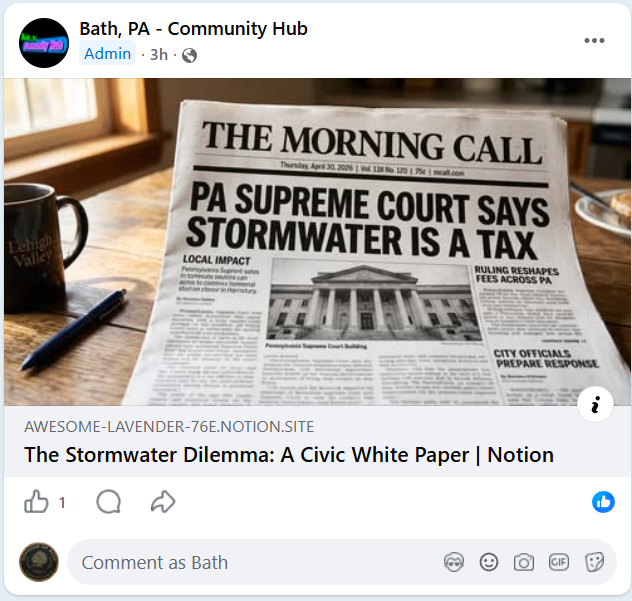
Bath PA, Community Hub’s Use of The Morning Call Graphic (posted May 11, 2026) – Verified FAKE

The Morning Call confirmed the circulating graphic on social media is not authentic. The paper also confirmed it did not publish a story with that headline or framing.
Why this is Important?
First, visual credibility can be misleading. Most people don’t fact-check newspaper layouts. When something looks like a trusted publication, it is often accepted as real without verification.
Second, the headline framing drives public perception. The phrase “Stormwater is a tax” presented as definitive legal conclusion. In realty, court decisions are nuanced and context-specific not headline absolutes.
Third, this misattribution creates a false authority. By using a recognizable news brand, the graphic implies independent journalistic verification, suggests broader media coverage that doesn’t exist, and it amplifies the claim beyond its actual legal context.
Forth, this can impact public decision-making. Especially when residents rely on inaccurate or misattributed information. This leads to undermining trust in local government. It distorts informed discussion about fees, infrastructure, and legal obligations.
Finally, it unnecessarily complicates public understanding of complex issues like stormwater regulation.
How you can Evaluate Similar Claims
- Check if the story exists on the news outlet’s website
- Compare with the actual publication (date matters)
- Look for supporting coverage from multiple credible sources
- Be cautious of screenshots without links to the article
The Bath Borough Stormwater Authority encourages all residents to verify information using original and credible sources. When materials are presented in a way that mimics trusted publications but are not authentic, it can lead to confusion and misinformed conclusions about important community issues, such as stormwater management.
Michael Long’s The Stormwater Dilemma: A Civic White Paper published May 11, 2026
As an attention seeking piece, the use of a fabricated or stylized newspaper front page may create the impression of independent media confirmation where none exists. This increases the likelihood of public misunderstanding and reinforces the need for clear, controlled Bath Borough Stormwater Authority messaging (see referenced image below).
BATH BOROUGH STORMWATER AUTHORITY
Claim vs. Fact: Understanding Recent Discussions on Stormwater Fees
The Borough and Bath Borough Stormwater Authority (BBSA) are aware of a recently circulated document titled “The Stormwater Dilemma: A Civic White Paper”
This page provides clarification of key claims made in that document, using verified information, current law, and publicly available records.
Key Context Before Reviewing Claims
- The Pennsylvania Supreme Court decisions referenced in the paper (Borough of West Chester v. PASSHE) is fact-specific and applies a case-by-case legal test.
- No court has ruled on the Bath Borough Stormwater Authority.
- The BBSA is currently reviewing legal developments with counsel, as are municipalities and authorities across Pennsylvania.
CLAIM vs. FACT
Claim 1: “Stormwater fees like Bath’s are now legally taxes.“
FACT: This is NOT a settled legal conclusion.
The white paper states that the Supreme Court decision “changes the legal posture of every similarly structured stormwater charge.”
CLARIFICATION:
- The Court did not issue a statewide ruling invalidating all stormwater fees.
- The decision applies a two-step legal test that depends on: 1) how a specific program is structured, and 2) how it operates in practice.
- No court has applied the test to the BBSA.
At this time, this remains a legal question under review, not a resolved outcome.
Claim 2: “If the charge is tax, BBSA has no authority to impose it.”
FACT: This is partially correct, but incomplete.
The paper argues that authorities cannot impose taxes and therefore BBSA would lack authority (Section 2 – For Lawyers).
CLARIFICATION:
- It is true that municipal authorities: may impose RATES and CHARGES, not TAXES
- However: the BBSA was created under the Pennsylvania’s Municipal Authorities Act, which expressly authorizes stormwater management and rate-setting.
- The legal issue is not whether BBSA can exist– it is how a court might classify the charge under specific facts.
This is a classification issue, not a blanket lack of authority.
Claim 3: “Bath is in the same legal position as West Chester.”
FACT: That determination has not been made and cannot be assumed.
In Section 1 – For the People, the paper asserts that Bath’s program is “substantially similar” to West Chester.
CLARIFICATION:
- Courts evaluate: program structure, governance, funding mechanisms, and operational relationships.
- BBSA is a municipal authority, not a borough-run program.
- Differences in structure, agreements, and implementation matter legally.
Similarity is an argument, not a legal finding.
Claim 4: “The charge is compulsory and therefore a tax.”
FACT: Compulsion is only one factor in a broader legal test.
In Section 2 – For Lawyers, the paper emphasizes that property owners cannot opt out.
CLARIFICATION:
- The Court’s test considers: the nature of the service, the relationship between payer and provider, and whether the activity is public or quasi-private.
- Many lawful utility charges (e.g., sewer, water) are also compulsory.
Compulsion alone DOES NOT DETERMINE whether a charge is a tax.
Claim 5: “The way funds are used proves it is a tax.”
FACT: Program expenditures must be viewed in full context.
Under Section 2 – For Lawyers, the paper argues that spending on administration, compliance, and planning supports “tax” classification.
CLARIFICATION:
- Stormwater programs must fund: engineering, regulatory compliance (MS4 permit requirements), design and planning, as well as construction and maintenance that directly benefit every property owner requiring access to the Borough’s stormwater system.
- Early-state infrastructure programs commonly: incur upfront administrative and engineering costs and have delayed construction timelines.
Spending patterns alone do NOT determine legal classification.
Claim 6: “Billing amounts and projects show inconsistency or overcollection.”
FACT: Early program finances often differ from initial estimates.
The white paper compares an early $200,000 target to higher initial billing totals (Section 3 – The Financial Picture).
CLARIFICATION:
- Program estimates evolve based on: engineering updates, regulatory requirements, project refinement.
- Revenue must support: multi-year capital planning, compliance deadlines, and debt financing (PennVest Loan).
Variance between early estimates and actual billing is NOT unusual in infrastructure programs.
Claim 7: “There is no visible evidence supporting the stormwater projects.”
FACT: Visual comparisons do not replace engineering or regulatory analysis.
Under Section 4 – The Record, of the white paper, it argues, using aerial imagery, questioning sediment modeling and project needs.
CLARIFICATION:
- Stormwater planning relies on: hydrologic and hydraulic modeling, watershed-level calculations, and DEP-approved methodologies.
- Many stormwater impacts: are NOT visible from aerial imagery and occur incrementally across a drainage system.
Visual observation alone is NOT a reliable basis to evaluate stormwater compliance or project necessity.
Claim 8: “Residents should take specific actions regarding their bills.”
FACT: The Borough or BBSA cannot provide individual legal advice.
Under Section 1 – For the People, the white paper outlines options such as paying under protest or seeking legal remedies.
CLARIFICATION:
- Residents always have the right to: seek legal counsel and make individual financial decisions.
- The Borough and BBSA: cannot advise residents on legal strategies, but will continue to administer the program under current law unless directed otherwise by a court.
Mr. Long’s ‘white paper’ raises legitimate legal questions, presents a specific legal interpretation, but it also overstates certainty, assumes outcomes that have not been decided, and it blurs the line between analysis and conclusion. The paper walks right up to a legal conclusion while claiming it isn’t making one.
The BBSA was created under Pennsylvania law to manage required stormwater obligations directly benefiting each property of the Borough using the Borough’s stormwater system.
The recent Supreme Court decision is being carefully reviewed with legal counsel. No court has ruled on the legality of the BBSA. The BBSA will continue to monitor legal developments, provide updates as appropriate, and ensure compliance with applicable law.
QUESTIONS?
Residents with questions about the stormwater program may contact the Borough Office or attend a public meeting of the BBSA.
BBSA Public Statements Since West Chester Court Decision
May 7, 2026 – Third Public Statement
THIRD UPDATE – STATEMENT FROM THE BATH BOROUGH STORMWATER AUTHORITY
The Bath Borough Stormwater Authority (BBSA) is aware that information and opinions regarding the recent Pennsylvania Supreme Court decision in Borough of West Chester v. PASSHE are being shared within the community.
As publicly stated, April 30th and May 2nd, the BBSA is actively reviewing the decision with legal counsel to evaluate any potential implications to the BBSA and the BBSA’s structure and operations under the Municipal Authorities Act (MAA).
The BBSA administers a stormwater management program pursuant to its statutory authorization under Pennsylvania law. There has been no court order or decision that requires any change to the BBSA’s program and the BBSA will continue to operate and collect applicable fees as it has been since its creation. The above-referenced case involving the Borough of West Chester does not change anything in relation to the BBSA, which is a municipal authority.
The BBSA will continue to monitor developments and will issue additional guidance if warranted following the completion of its legal review.
Questions may be directed to the Borough Office (610) 837-6525.
BBSA Board of Director meetings are held on the 4th Monday of each month (except holidays; meeting then falls on a Tuesday) 6PM, Borough Hall.
BTF
May 2, 2026 – Second Public Statement
UPDATED STATEMENT FROM THE BATH BOROUGH STORMWATER AUTHORITY
The Bath Borough Stormwater Authority (BBSA) is aware that information and opinions regarding the recent Pennsylvania Supreme Court decision in Borough of West Chester v. PASSHE are being shared within the community.
As stated, April 30th, the Authority is actively reviewing the decision with legal counsel to evaluate any potential implications specific to the BBSA and to the BBSA’s structure and operations under the Municipal Authorities Act (MAA).
Key distinction: the West Chester case addressed how a stormwater charge was structured in a different municipality (a Borough, not Municipal Authority) and did not directly evaluate or invalidate stormwater programs operated by municipal authorities.
The Authority administers a stormwater management program pursuant to its statutory authorization under Pennsylvania law. The program is funded through user fees that are established as reasonable and uniform rates based, in whole or in part, on property-specific characteristics, including impervious surface area (in accordance with the MMA).
At this time:
• There has been no court order or directive requiring changes to the Authority’s program
• The Authority continues to operate under its existing legal framework and adopted Rules and Regulations
• Billing procedures remain unchanged unless and until official notice is provided
The Authority will continue to monitor developments and will issue additional guidance if warranted following completion of its legal review.
Residents and property owners are encouraged to rely on official communications issued by the Authority for accurate and timely information.
Questions may be directed to the Borough Office at (610) 837-6525.
April 30, 2026 – First Public Statement
***STATEMENT FROM THE BATH BOROUGH STORMWATER AUTHORITY***
The Bath Borough Stormwater Authority is aware of the recent Pennsylvania Supreme Court decision in the case captioned as Borough of West Chester v. PASSHE regarding stormwater fees across the Commonwealth.
At this time, the Authority is carefully reviewing the Court’s decision with legal counsel to fully understand its potential implications. Stormwater management remains a critical responsibility for the Borough and the Authority, including compliance with state and federal environmental regulations, flood mitigation, and protection of local waterways.
The Authority’s stormwater program was established to equitably distribute the costs of managing stormwater based on impervious surface area and to encourage property owners to reduce runoff through available credits and best management practices.
At this time, there are NO IMMEDIATE CHANGES to the Authority’s billing or operations. Residents and property owners must continue to follow existing billing procedures unless otherwise notified.
Additional guidance will be released as it becomes available.
BTF
Additional Questions Through June 19, 2025
Why is the credit for a rain barrel only a one-year credit, if the rain barrel is functioning for multiple years?
The rain barrel rebate is a one-time rebate that applies to the billing period in which the application for credit is submitted, without regard to how many years the rain barrel is operational. The Authority believes that this fairly accounts for the impact of a rain barrel on the Borough’s stormwater management system.
Why is the credit for an existing rain barrel not applied for 2025, instead of 2026?
The credit may be applied for 2025 provided the application is submitted in time. The Credit & Appeals Manual at section 4.1(7) provides: “Approved credits and appeals will be made effective on the following billing cycle if the determination is made 30 days prior to the next billing date. However, any credits for BMPs fully installed as of January 1, 2025 shall have the credit applied retroactively to that date if credit application for the BMP is submitted, in full, to the Authority no later than September 30, 2025. Similarly, any appeals submitted prior to September 30, 2025 will be retroactively applied to January 1, 2025.” Therefore, if the rain barrel already exists and the credit application is submitted by 9/30/25 and is approved by the Authority, the credit will be applied retroactively to 1/1/25.
Why is a large property owner charged more per square foot for impervious coverage when they are already charged more for having more square feet? Isn’t that like charging them twice?
Properties with at least 4000 square feet of impervious area are charged based on a base unit multiplied by their total impervious area. This allows for more precise billing to account for that property’s impact on the Borough’s stormwater management system.
These properties are not being charged twice, rather they are being charged a single fee based on the actual impervious area their property contains. Often, properties with higher total amounts of impervious area also have a higher ratio of impervious area compared to the pervious area on the property. This results in greater stormwater runoff from the property and, consequently, a higher demand on the Borough’s stormwater management system.
In addition, the Authority offers credits to properties that have a low ratio of impervious area to pervious area, to account for the relatively lower impact they have on the stormwater management system and ensure they are treated equitably.
How many other stormwater authorities exist presently in Northampton County?
Three. Bath Borough Stormwater Authority. Palmer Township Stormwater Authority. And the Bethlehem Township Stormwater Authority.
Both, the cities of Easton and Bethlehem charge stormwater fees through a department of their respective cities under applicable state law.
April 28, 2025, Bath Borough Stormwater Authority Meeting – Public Comment Questions
Of the revenues being collected in 2025, what percentage is going towards the retention pond (Pollution Reduction Plan Projects)?
The BBSA is collecting revenues to handled ongoing storm sewer maintenance, regulatory compliance, and capital projects, such as retrofitting three (3) retention ponds within the Borough. The BBSA does not have a breakdown per se of what portion of the stormwater bill is being used for the retention ponds. Once the BBSA has collected (or can demonstrate) up to two years of revenue generation, the BBSA will finance the construction of the retention basin projects through general obligation notes and/or bonds. Stormwater bills pay for all the costs associated with the Borough’s Stormwater Management Program.
Assuming everyone pays their stormwater bills, what is the total expected revenue to be collected in 2025?
The BBSA has billed 1,012 accounts with an anticipated revenue collection (assuming 100% collection rate) in the amount of $285,254. This amount reflects total billing both pre-credit and pre-appeal. Meaning the total amount billed is expected to be reduced for a number of reasons: deactivated accounts, credits, appeals, nonpayment, etc. The BBSA has already identified a number or accounts that will need to be deactivated, such as the Bathview Phase I condominium building (All three floors were individually billed instead of as a whole. This created a double billing scenario.)
If the BBSA is collecting money for stormwater projects and that money is diverted, what will the money be used for?
By law, the money raised through the BBSA, and stormwater bills, can ONLY be used for its Stormwater Management Program.
Is there a way to see the billing of the different properties within the Borough?
The BBSA has posted the Financial Analysis Map of the entire Borough on its webpage. The map is as good as its published date. Changes to impervious coverage areas are ongoing through the appeals process. The BBSA may publish new maps in the future. The webpage listed also contains the billing methodology provided to the BBSA by its Engineer. The Engineering memorandum can be found at the bottom of the webpage.
Has the impervious coverage data taken into consideration previously installed Best Management Practices within a property?
No. The BBSA is using aerial photography and GIS to generate areas of impervious coverage. The imaging has no way of knowing what BMPs may exist on any one particular property. This is where the property owner files for a BMP credit. The credit application must provide the BBSA with all necessary information in order to make a determination as to the type and value of the credit that should be granted, if any.
Is there a deadline to file for an impervious coverage appeal?
No. There is no deadline to file for an appeal.
I have a large commercial property, if I covert some of the impervious coverage area to pervious coverage, can I receive a prorated credit?
If a property owner is reducing the overall impervious coverage to pervious, the property owner could file for an impervious coverage appeal. Keep in mind, excavation work occurring on a property may trigger a Borough Zoning Application and Grading Plan submission. The Grading Plan may need to be reviewed by the Borough Engineer. Grading Plan reviews require a Professional Services Agreement and the establishment of an escrow fund to conduct such reviews. If there is more than one (1) acre of earth disturbance, this could trigger other Act 167 requirements and County Conservation District permitting processes, which could become costly.
Why isn’t the stormwater bill simply a flat fee, regardless of a property’s impervious square footage?
The BBSA reviewed a ‘uniform or target rate’ but determined that the best option for a fair and equitable distribution of the fee was based on a Tiered System of impervious coverage. The larger impervious coverage properties would foot a larger portion of their contribution to the storm sewer system. The Tiered System captures a property’s more direct impact to the overall storm sewer system. In other words, the Tiered System of impervious coverage is considered a ‘fair approximation’ by the BBSA to the level of service a property receives in stormwater management by the BBSA.
In terms of stormwater billing fairness, think about two properties of vastly different impervious coverage area. For this example, think about the property where Ahart’s Market is located (326 S. Walnut Street), comparing that against Papa Sarge’s Perogies (120 S. Walnut Street).
Ahart’s Market has an estimated 103,507 square feet of impervious coverage. Papa Sarge’s has roughly 4,352 square feet of impervious coverage. The Borough considered a flat stormwater fee of $236 (total cost of the MS4 program divided among all properties of the Borough) per parcel. Under this scenario, Ahart’s Market, with 24 times more impervious coverage than Papa Sarge’s, requiring more of a demand on the Borough’s MS4 system than Papa Sarge’s property, would both be paying an equal stormwater bill under this uniform rate. This would not be a fair fee and would likely subject the BBSA to legal challenges.
In terms of assessing a uniform rate, such as $0.00375 per square foot of impervious coverage. This type of billing structure would be labor intensive and would only serve to drive up stormwater billing costs. While it could be considered an accurate billing system, it would require more sophisticated GIS analyzation on a per parcel basis. This would require more engineering and staff time (billable man-hours) to assess and maintain every property, creating individualized bills per parcel.
Did the Borough consider any other projects, such as stream bank enhancement, silt retention in catch basins/filter bags, which similar projects could be a lot less expensive; who’s made the decision to move forward with the current Pollution Reduction Plan projects?
BBSA’s current Engineer, Colliers Engineering & Design, did not come up with the projects outlined in the Borough’s approved 2023 Pollution Reduction Plan. These projects were provided by Keystone Consulting Engineering, under DEP guidelines to reduce the Borough’s sedimentation loading by 10% no later than December 31, 2027. Borough Council adopted the PRP, including the projects outlined within the PRP, in December of 2023.
KCE was to find areas of the Borough where such projects would meet DEP’s requirements but not fall within private property. KCE prioritized Borough owned property for project implementation. The third project is located on the Northampton Area School District property where an easement was easily granted. The three PRP projects meet DEP’s requirements for at least a 10% sediment loading reduction. For these reasons, the retention base retrofit projects were selected during this latest NPDES permit cycle.
DEP has also disclosed that stream bank enhancement projects will not be considered for future credit work relative to Pollution Reduction Plans.
Is there any fee controls? Is there a chance the stormwater invoice could double by 2027?
The BBSA is evaluating yearly program costs to determine the rate payer fee necessary to cover program costs. At this time, the BBSA is under the assumption the current stormwater billing rate is adequate to cover costs, given data known at the time the bills were issued. The stormwater fee may be adjusted at some other point in time. The BBSA cannot speculate as to whether the stormwater fee will in fact double by 2027.
Borough Public Works employees are working for the Authority, is that billed at a premium? Who decides what hours the PWD employees are working for the Authority?
Public Works employees (and administrative personnel) are serving the BBSA through a Management Agreement. Employees of the Borough are logging work hours related to BBSA activity. In the case of the Public Works employees, they have their normal Borough work tasks to perform. At present, the differentiation of work is managed by the Public Works Crew Leader and Borough Manager as operational demands dictate for either discipline. For now, the Borough is billing at the highest fully loaded Public Works employee wage rate. Borough invoicing to the BBSA is occurring quarterly. All BBSA financial data (income and expenses) are open to public inspection by following this link.
[Was not a questioned asked during the meeting but is a shared public concern.] If the BBSA is paying Borough staff or for functions that were ordinarily paid for under the Borough’s General Fund, will the Borough consider a property tax decrease, since stormwater bills have now been implemented?
This will be the first year the Borough will be able to review its General Fund expenses to analyze cost-offsets by the BBSA. The Borough was not doing nearly enough stormwater management work in the past because of funding limitations. There is a lot more stormwater management work that needs to be funded. The General Fund also has a significant number of projects that need funding. The Borough is also fighting through the rising costs of goods and services. Council is also targeting the expansion of its Capital Improvement Fund. So, while yes, there is some benefit and cost-offsets with the BBSA paying the Borough for staff and other tasks normally funded by the General Fund, it is way too early to tell if this will, if at all, result in a property tax decrease.
Stormwater in General
It’s just rainwater, what is the big deal?
Stormwater runoff creates several layers of problems in urbanized areas, like Bath. Water quality is threatened. As stormwater flows across the ground surface, it collects pollutants such as oil, pesticides, sediments, bacteria, pet waste, and trash, and carries them into the receiving waterways, such as the Monocacy Creek.
Why is Bath regulating stormwater runoff?
Bath is mandated to.
It starts with the federal Clean Water Act (CWA) of 1972. The CWA established the National Pollution Discharge Elimination System (“NPDES”) program, authorizing the Enviornmental Protection Agency (“EPA”) to issue permits allowing storm water discharge, and delegates the NPDES permitting program to states with a counterpart program to meet specific minimum criteria. Pennsylvania is one such state. EPA has delegated the Pennsylvania Department of Enviornmental Protection (“DEP”).
Pennsylvania protects its waterways through the state constitution and law. Article 1, Section 27 of the Pennsylvania Constitution (the “Enviornmental Rights Amendment” or “ERA”). Pennsylvania’s General Assembly has also passed the Clean Stream Law (“CSL”) and Act 167, Stormwater Management.
Bath is a municipal storm sewer system (MS4) community that must obtain a NPDES permit for stormwater discharges, develop a Stormwater Pollution Prevention Plan and implement measures that prevent discharges of the pollutants in stormwater runoff.
Bath is required by federal and state law to manage its stormwater within its regulated MS4 area.
What is MS4?
MS4 stands for Municipal Separate Storm Sewer System. This system is owned and operated by a public body, in our case the Borough, and includes inlets, basins, man-made channels, storm drains, and various other stormwater conveyance systems to the Monocacy Creek.
Why has the importance and cost of stormwater management become so expensive?
In the United States, the Environmental Protection Agency (EPA) is charged with regulating stormwater pursuant to the Clean Water Act (CWA). Portions of the stormwater requirements of the federal CWA are administered under the Pennsylvania Department of Environmental Protection’s (PADEP) Municipal Separate Storm Sewer System (MS4) Program.
As part of Bath’s 2023 MS4 permit, the Borough is faced with new unfunded mandates, resulting in the need to spend considerably more money over the five-year permit cycle than ever before to improve stormwater runoff quality.
What aspects of stormwater must be addressed to meet these new regulations?
The Borough is required to complete pollutant reduction planning and implement Best Management Practices (BMPs) to reduce pollution loadings entering our local waterways. Over the 2023 permit term (2023-2027) Bath is required to reduce sediment by 10%. In addition, there are six Minimum Control Measures (MCMs) that the Borough is mandated to follow, each containing their own set of BMPs. The six MCMs are listed below with examples of their BMPs:
- Public Education and Outreach on Stormwater Impacts: Distribute educational materials in the form of a newsletter, flyer, or a website that includes general stormwater educational information.
- Public Involvement and Participation: Provide opportunities for residents to participate and provide input in the form of public meetings or other events.
- Illicit Discharge Detection and Elimination: Develop and implement a plan for the detection, elimination, and prevention of illicit discharges to the storm sewer system.
- Construction Site Stormwater Runoff Control: Develop, implement, and enforce an erosion and sediment control program for construction activities that disturb one or more acres of land.
- Post-Construction Stormwater Management (PCSM) in New Development and Redevelopment: Develop, implement, and enforce a program to address discharges or post construction stormwater runoff from new development and redevelopment areas. Applicable controls could be the use of structural BMPs such as vegetated swales and detention basins.
- Pollution Prevention and Good Housekeeping: Develop and implement an operations and maintenance (O&M) program that includes training components and plans to reduce polluted runoff from municipal operations.
What are BMPs?
Stormwater management BMPs–or Best Management Practices– are control measures used to improve water quality by reducing contaminants that enter local waterways. BMPs are designed to reduce stormwater volume, peak flows, and nonpoint source pollution through evapotranspiration, infiltration, detention, and filtration. Examples of BMPs include stream bank stabilization, detention basin retrofits, rain gardens, bio swales, permeable pavement, street sweeping and installation of community rain gardens.
How do I affect stormwater runoff?
Stormwater management involves managing rainwater that is not absorbed by our lawns and gardens. Impervious surface on your property may impact the quantity of stormwater runoff that will be managed by the Borough of Bath. Also, household tasks such as car washing and use of fertilizer can impact stormwater quality. All residents utilize the stormwater system, and everyone should play a role in supporting its maintenance and upkeep.
What is Impervious area?
Impervious area is any surface which prevents infiltration of rainfall into the soil. This includes pavement (asphalt, concrete, etc.), rooftops, decks/patios, pools, sidewalks, and compacted graveled surfaces such as parking areas and driveways.
What is an illicit discharge and how do I report one?
The Environmental Protection Agency (EPA) defines illicit discharges as “any discharge to the storm sewer system that is not composed entirely of stormwater.” Illicit discharges can be from car wash wastewater, spills from roadway accidents, failed septic systems, and improper disposal of household toxins and detergents. These substances can either enter our waterways through direct connections or indirect connections. It is always good to monitor the stormwater inlets near your property. If you see someone dumping, please call the Borough Office at 610-837-6525 or the PA DEP 24-hour hotline at 570-826-2511.
You can also report illicit discharges here.
Stormwater Utility Fee Concept
Why is the Borough considering Stormwater Utility Fees?
The Borough is required to perform stormwater management and levels of service surrounding stormwater needs. The Borough must consider any known, scheduled stormwater improvements, and future projects necessary to comply with future regulatory requirements and expenses over the next 5 and 10 years. Capital construction costs and operational maintenance is likely to be divided by the impervious area in the Borough to come up with a Stormwater Utility Fee.
Every property within the Borough limits has the privilege and benefit of discharging rainwater runoff into the storm sewer system the Borough is required to manage. The Borough must be reimbursed for the stormwater management services its required to provide.
Where would all the money collected from the Stormwater Utility Fee go?
All stormwater revenue will be placed into a dedicated fund used only for the Borough’s Stormwater Management Program, such as the operation, maintenance, and improvement of stormwater infrastructure. Funds will cover costs associated with the following:
- Operation and Maintenance of Stormwater Infrastructure – Bath owns roughly 5.8 linear miles of storm sewer gravity lines, 350 storm sewer structures (inlets, manholes, flared-end sections, end walls, headwalls, and pipe ends– includes 17 outfalls into the Monocacy Creek), 2 stormwater detention basins and 2 rain gardens. Enhanced maintenance of these facilities is necessary to reduce flooding, improve public safety and extend the useful life of stormwater assets.
- Regulatory Compliance – The Borough is required by state and federal regulations to reduce stormwater pollution and improve water quality for local streams.
- Capital Improvement Projects – Pollution reduction projects are being planned for two retention ponds in the Holiday Hill Subdivision and a rain garden located on George Wolf Elementary School property.
Would the Stormwater Utility Fee be paid by everyone, including non-profits?
The fee would be paid by all property owners who own developed property in the Borough, whose property has impervious surfaces (roofs, driveways, sidewalks, walkways, roads, parking lots, etc.). Non-profits will pay because it is a fee and not a property tax. Property taxes are based on the assessed value of the property and the stormwater utility fee is based on how much a property contributes to stormwater runoff. Tax-exempt properties are generally required to pay for other utility charges including electric, water and sewer and the stormwater utility fee is no different.
How is this different from a tax?
All developed properties contribute stormwater runoff and should pay the stormwater fee; however, some properties are exempt from taxes. Unlike taxes, which are used for general services that the Borough provides, the revenue from the stormwater fee can only be used for stormwater management and cannot be redirected for other uses.
Tax revenue is based on generating money for the taxing authority’s general purposes. Fees are charged to impose a specific regulatory purpose, in supporting the cost of carrying out regulatory schemes, such as stormwater management. Fees cannot be used for general purposes as tax revenue can.
What about the Borough and state-owned streets, those are impervious areas; who pays the fee for those areas?
Borough and state-owned streets are impervious coverage areas. Roads are pitched, typically toward storm water gutters (the curb-line) and ultimately into storm water inlets. Therefore, streets are considered part of the storm water conveyance system, and those areas do not generate a fee.
Why not just include the stormwater program costs in our property taxes?
Pay a Storm Sewer Utility Fee or higher Property Taxes?
- Stormwater management fees are the least burdensome way for local governments to pay for compliance. Tax increases would be unpopular and imposes costs on the population as a whole rather than target properties that generate stormwater.
- Stormwater utility fees are fairer than taxes, because tax-exempt entities like government and nonprofit organizations that often generate significant stormwater runoff will pay stormwater fees.
- Designing stormwater utility as a fee requires the fee to be based on benefits conferred with providing a service, which is management of stormwater runoff. This fee is structured around property characteristics, such as impervious surface area. This is because stormwater billings directly associate with runoff a property generates. Tax generation involves assessment of property value and has nothing to do with impervious surface coverage.
- If a stormwater fee was simply dealt with as an ordinary increase in taxes, the effect would be residential property owners subsidizing costs for runoff generated from larger tax-exempt properties.
- An advantage of a fee-based system is that the Borough can offer credits to property owners who reduce the quantity of stormwater or improve the quality of stormwater leaving their property. The Borough is considering a credit policy that provides a reduction in the stormwater utility fee for property owners who make stormwater runoff improvements. Bath cannot grant utility fee credits on a tax-based system.
- Fee-based structures are more equitable and dramatically cheaper (in part, for reasons stated at #5) for the average residential property owner. An engineering study across roughly 40 municipalities surveyed indicated that the average property owner saves between 50%-70% on their stormwater bill by paying a fee rather than a tax (according to HRG and the Wyoming Valley Sanitary Authority).
- Tax revenue can be used for general purposes. The Borough could, (with good intention, raise taxes for MS4) but then spend tax money on other projects, or out of necessity, ultimately failing to fund necessary MS4 improvements. Whereas revenue generated from a stormwater fee can only be used for stormwater management purposes and nothing else.
How would impervious surface areas be determined?
Likely process: Aerial photographs of the entire Borough would be taken. These photos would then be geometrically corrected for the use in Geographic Information Systems (GIS) software. In GIS, the impervious area features would be identified and plotted throughout the Borough. This information can then be utilized to determine the amount of impervious located on each property. This is how the Borough could determine ‘base rates’ of impervious coverage sampling several zoning districts within the Borough. This is an example approach.
There are no storm sewers on or near my property. Why should I pay a fee?
All properties produce stormwater runoff that contribute to pollution and flooding downstream. Even if your property has never flooded and/or there are no nearby storm sewers, the stormwater that flows off your property must be managed by the Borough of Bath. Stormwater management is a community-wide service that benefits the whole Borough, and the program costs need to be distributed to all residents.
All property owners benefit from the management of stormwater along public streets which they travel. The fee will also help cover other services provided by the Borough, such as stormwater system maintenance and permit compliance. Since there are additional services provided by the Borough, property owners who manage the majority of stormwater onsite will still pay a fee to help cover the additional services provided by the Borough beyond their property lines.
How much would this storm sewer utility fee cost?
In Bath, it’s too earlier to tell until statistical data and impervious coverage studies have been completed.
In Pennsylvania, the average storm water runoff utility fee is between $6.50 and $8.50 per month (according to Herbert, Rowland, and Grubic, Inc.). Based on this survey, the anticipated stormwater fee for the average property owner is between $90 to $100 a year.
How would properties be billed?
A new stormwater bill could be issued on a quarterly basis. The details are still being worked out.
How is unoccupied property going to be treated?
It is likely, if unoccupied property contains impervious area (vacant residential structures, empty commercial/industrial buildings, driveway, etc.), it would be subject to a stormwater utility fee. These properties would continue to generate stormwater runoff just the same as an occupied property.
How is undeveloped property going to be treated?
Undeveloped property is property that has not been altered by improvements such as buildings, parking lots, structures, or the addition of any other impervious areas. Since there are no impervious areas on these properties, undeveloped properties will likely not be charged a stormwater fee. Similarly, properties falling under 300 square feet of impervious area could also be treated as undeveloped properties.
Doesn’t the Borough already have a stormwater system in place? Nothing has changed on my property, so why would I be charged now?
The Borough has had a stormwater system in place for many years; however, there are areas of the Borough that do not have the appropriate infrastructure to handle the rainfall events we’re experiencing today.
In recent years, there has also been an increased emphasis on stormwater management. New and revised state and federal regulations require a comprehensive stormwater management program.
A stormwater utility fee ensures that the Borough receives adequate financial support to meet its responsibilities to manage the stormwater system more closely, identify and eliminate illegal discharges, provide public education, and other regulatory requirements.
The fee will also be used to cover the cost for increased inspection and maintenance of aging infrastructure, implementation of flood reduction projects and the ability to rehabilitate/replace infrastructure that’s reached the end of its useful life.
Why should I pay for rain falling on my property?
Property owners are not being charged for rain falling on the surface. Instead, the charges would apply to runoff that’s discharged into the stormwater system when it rains.
As rain falls on impervious surface, it collects pollutants. The amount of pollutants contained in stormwater can be correlated to the amount of impervious surface on your property.
Additionally, proper stormwater management is vital to ensuring flood risk is minimized. Through the implementation of the fee, a dedicated funding source will be in place to help manage stormwater in flood prone areas.
Would there be a way that I can appeal how much I’m being charged?
Yes. There would be an appeals process in place to challenge the rate of the stormwater utility fee you pay.
Would there be a way to reduce my stormwater utility fee?
Yes. There is a stormwater utility fee credit program. Follow this link for more information.
What about grant opportunities? Isn’t there grants out there to help fund stormwater projects?
The Borough will continually monitor for potential grant opportunities that may be applied against capital MS4 projects. One problem Bath faces is the size of its local stormwater projects. For state funding, Bath’s projects fall under minimum cost thresholds to apply.
In most cases with grant opportunities, applications still require a 50/50 match of funds. Bath would need to cover half of all costs associated with the grant application. For example, Bath looked into PA Department of Economic Development grant funding, finding that those programs had a minimum project cap of $500,000 and the municipality needed to match $500,000. Bath doesn’t have MS4 projects in the million or multi-million-dollar range.
Here are other issues: Grants are on different timelines than the requirements of the Borough’s NPDES permit timelines. Plus, grants are typically not geared to manage long-term operational maintenance activity.
Grants will require engineering design and plans. Bath does not have capital project engineering design plans in place because there hasn’t been funding set aside to do this work. These are costs in addition to the grant application.
There may be financial resources through Pennvest. This program has some grant opportunities; however, the PA Department of Enviornmental Protection (DEP) has input in grant allocations at that level and the money is generally reserved for 100% entitlement communities. Pennvest generally offers low-interest loans for stormwater projects. Under a loan or general obligation approach, Bath would need to document at least two years’ worth of fee revenues, typical of securing loans of this nature.
Either way, Bath can’t rely on the variability of grant funding. Stormwater utility fees provide a continual stream of revenue to handle Bath’s short and long-term MS4 program requirements.
Are swimming pools considered impervious coverage for the basis of determining impervious coverage area?
Yes. Pools are not considered the same as a cistern or stormwater retention pond. Swimming pools are structures placed on top of pervious ground that act to prevent water from draining into the ground naturally. Swimming pools do not comply with the operation and maintenance standards for an eligible best management practice and must be considered as impervious.
Under DEP’s proposed MS4 permit cycle and new model stormwater management ordinance, pools are specifically defined as Impervious Surfaces.
Are decks considered impervious coverage?
Yes. The Bath Borough Stormwater Authority (BBSA) defines an “Impervious Surface” as a surface that prevents the infiltration of water into the ground. Impervious surfaces (or areas) shall include, but are not limited to, roofs, additional indoor living spaces, patios, garages, storage sheds and similar structures, streets, sidewalks and vehicle, pedestrian areas that are gravel and crushed stone. Decks are considered ‘similar structures’ under the defined term because decks prevent infiltration of water directly into the ground.
NOTE: The BBSA will be evaluating decks as it relates to impervious coverage in the future once DEP’s model guidance of the next permit cycle is released. BBSA’s interpretation of decks with respect to impervious coverage may change.
Stone driveways are not considered pervious?
Correct. Bath’s Stormwater Managment Program has a defined term regarding ‘impervious coverage’. This definition is found in the Rules, Rates, and Regulations Manual on the Bath Borough Stormwater Authority webpage. This definition is borrowed directly from PA DEP guidance.
Storm Water Authority Concept
Is Bath considering a Storm Water Authority?
Yes. It is a possibility Bath may create a Storm Water Authority to assist with managing the Borough’s MS4 program.
Why is the Borough considering a Storm Water Authority?
The Pennsylvania Borough Code that governs Bath has not caught up with current storm water regulations. While there are certain provisions that allow a borough to assess storm water fees, it is limited to specific stormwater projects where a property fronts the improvement. Plus, the current law prohibits the assessment of fees if state or federal grants are used toward a stormwater improvement project. As the law stands today, storm water fees cannot be assessed on a community-wide basis. These are reasons why the Borough cannot simply implement a stormwater fee absent an authority.
Plus, there is a recent court decision (Borough of West Chester v. Pa. State System of Higher Education and West Chester University of Pa the State System of Higher Education, No. 260 M.D. 2018; Pa. Cmwlth. Jan 4, 2023) that has made it more difficult for local municipalities to impose stormwater fees in carrying out state/federally mandated stormwater management duties. The Pennsylvania legislature has generally paused on amending the Borough Code, because of the court challenges. While the township codes have been amended to allow charges for stormwater fees, the Borough Code is likely to be delayed until this current West Chester case works through the court system.
On July 13, 2023, the Borough of West Chester, along with several other municipalities, have appealed the Commonwealth Court’s decision to the Supreme Court of Pennsylvania. This case could take 1 to 3 years for resolution.
Bath is mandated under its current NPDES permit to make certain improvements to the stormwater system before December 31, 2027, regardless of the court battles or lag time from the Pennsylvania legislation to enact rules specifically authorizing boroughs to create stormwater fees. Bath may create a Storm Water Authority to assess storm water utility fees, authorized under the 2013 amendment of the Pennsylvania Municipal Authorities Act. Storm Water Authorities are becoming increasingly common in Pennsylvania to handle stormwater management.
Wouldn’t a new Storm Water Authority require a building, staff, and equipment?
No. Bath’s Storm Water Authority can operate through the Bath Public Works Department and the Borough Administration Office.
Are there any paid members of a Storm Water Authority?
The only salaried positions under consideration would be for the 5 member Storm Water Authority Board. Salaries are typically low, ranging under $5,000 per year for service to the Board. Details still need to be worked out. Board positions do not come with any fringe benefits.
Once enough money is raised to take care of the $500-$800k in initial storm sewer projects, what else is money needed for?
The continual operational maintenance costs of the Borough’s entire storm sewer system. To continue with the regulatory oversight of the Borough’s responsibilities under its NPDES permit. Funds will be needed to address the next five-year NPDES permitting cycle and thereafter. NPDES permitting requirements have only increased as time has transpired. Additional work and projects are assessed with each new permit cycle. Storm water pollution reduction and maintenance is an ongoing mandate. It doesn’t just stop after current required storm water pollution reduction improvements are completed.
Will the Storm Water Authority parse out exemptions for properties that have their own NPDES permits?
First, the Borough does not have property owners maintaining their own NPDES permits. Exemptions or parsing out a permit holder is also uncommon since there could be a wide variety of engineering reasons as not to exempt a property. For example, an industrial property with its own industrial NPDES permit could be a large contributor to the municipal MS4 system where that property would not receive an exemption.
Moore Township doesn’t do any of this stormwater billing. Why is Bath doing this?
Each municipality is different, and PA DEP requirements vary depending on the municipality’s census data.
Bath is designated an ‘Urban Area’; high population density per square mile. And because of this, Bath has to fall within mandatory stormwater pollution reduction practices. Under current PA DEP statutes, ‘Suburban’ and ‘Rural’ designations (where Moore Township is classified) those municipalities do not fall under the same guidelines as Bath Borough.
