
25 – Bath Community Hub Post, Michael Long | September 7, 2024
Post. Partially true. Repeated/cycled MISINFORMATION & Appeal to Pity.
The Post:
DISCUSSION:
Post Point #1 – “Mr. Flynn’s Employment Contract, this $1,100.99 aligns with a salary allocation in his contract.” FALSE. Something that ‘aligns’ and something that actually ‘is’– two different things. As the Borough previously explained under Item #24 of this webpage, the $1,100.99 payment is the net direct deposit for the mayor salary. Michael Long refuses to identify, in many cases, two issues, no matter how similar, are not connected.
Post Point #2 – “[M]y concerns were not to assume that these transactions were inappropriate but rather the absence of Mr. Flynn recording these supplemental additional salary outlays…” FALSE. Manager Flynn does not enter payroll data into QuickBooks. Bath has, for a number of years, maintained a separate bookkeeper to track and record payroll data in addition to using a third-party payroll processing company. To state that Manager Flynn did or through secrecy, didn’t record payroll data appropriately is false. As of 2024, and since 2016, Bath is on its third bookkeeper.
Post Point #3 – “After the borough’s exit from the CRPD contract in 2018, in which Flynn had a gross salary of $68k, he subsequently experienced an almost 25% raise and grew his salary to nearly $85k.” PATENTLY FALSE. This is a recycled false claim from 2023. (See Notable Statements of 2023 – Item #4). Manager Flynn’s salary, at no time, was ever adjusted 25% from a previous year. Manager Flynn doesn’t have any authority to increase his salary by that amount. Salary adjustments and raises are approved by Borough Council.
This post, and throughout the history of the statement, fails to consider key elements. That during this time, from about 2019 through 2022, Manager Flynn was asked to perform additional duties, outside of his normal management duties. Manager Flynn performed parking and code enforcement functions. Flynn agreed. The philosophy of then, President Mark Saginario, and the advice given to Borough Council would be to compensate Flynn out of separate General Fund ledger lines for these tasks. For the record, this was NOT Manager Flynn’s idea. In doing this, Manager Flynn’s salary was always calculated at around (for the sake of numbers) $70,000 or $80,000, portioned from different ledger lines. Part of Manager Flynn’s compensation included a vehicle stipend of $5,000. The vehicle stipend was paid for out of a General Fund ‘Borough Manager sub-account’ but wouldn’t be shown under the Borough Manager’s salary line. And that’s because it is a separate compensable item under the Borough Manager sub account.
After Saginario’s departure, by the end of 2021, President Michele Ehrgott wanted to change the manner in which Flynn’s salary was paid. Ehrgott, wanted the issue to be more transparent–clearer to see on paper. Council and Flynn later agreed on a full lump sum salary that included all original and added duties, as well as including Flynn’s vehicle stipend. The appearance of Flynn’s salary increasing 25%, was in appearance only. The inflated appearance occurred after restructuring and consolidating Flynn’s total compensation across different ledger lines into one. There was never an increase in pay by 25%. This was explained to Mr. Long. The explanation remains rejected by Mr. Long as he continues to claim–grossly overstate–Manager Flynn’s salary adjustments.
Post Point #4 – “Before my requests for RTK data, the only publicly available information a resident could access was preliminary budgets.” While true, in the past there was not a lot of data publicly available. Bath has always been working towards building its website and social media strength. Prior to 2021, Bath was in the midst of withdrawing from CRPD and trying to transition its operations from an old School House to a new facility. And during a time where Manager Flynn and many other community volunteers were actively taking part in renovating the Borough’s new municipal building. Bath was busy! Time couldn’t be designated to publishing material as it is today.
The point here is that this statement represents a true past and not what Bath is doing for the community now. Since 2022, Bath has more information online, especially financial information, available to its residents. More than it ever has at any other time in Bath’s history.
Post Point #5 – “I do it because I firmly believe that people deserve to know the truth.” Then tell the truth! There are more than 60 recorded instances on the Borough’s website of where either Michael Long or the Bath PA Community Hub is intentionally misinforming its public through the use of Borough records to represent something that the documentation does not represent.
Michael Long has a history of lying about facts to include filing court papers that contained several instances of non-existent case law. Mr. Long represented certain legal propositions as fact, when it was not. Mr. Long did this with laziness or intent aimed to inappropriately influence a Courts decision. Mr. Long has been candid about using artificial intelligence in the process. For the wrong reasons. (See DOCKET 2023-1598 (PENDING)) And all at the Borough’s expense. Taxpayers flipped the bill for the Borough to fight through Mr. Long’s court filed falsehoods. Wasting so much time and resources.
Post Point #6 – “As I’ve often witnessed, those who speak out or disagree with the handling of matters in the borough are quickly subjected to personal attacks and ridicule, usually led by the mayor, effectively silencing them.” While true, Mayor Mirabito will speak her mind and she can be verbally strong, it’s important to delineate this idea of being criticized for sharing one’s opinion and being criticized for making outright false claims in the public domain. Mr. Long isn’t comparing apples to apples here.
Let’s face it, Mr. Long isn’t just saying: How bad traffic sucks in Bath and I think Council’s to blame! Mr. Long is claiming the Borough Manager committed embezzlement– an arrestable offense. Mr. Long is relaying to Bath’s public that Manager Flynn violated public trust. And not just stating an opinion but making a definitive claim telling Bath’s public that embezzlement actually happened, and he has the proof using Borough records! Any false claims to this magnitude about Borough operations (especially with its own records) will be met with a response, in some way or another. The information published by Michael Long and the Bath PA Community Hub has been outright falsehoods, using Borough records in the most perverse way. The history has proven Mr. Long wrong over and over again. Bath will defend inappropriate use of its records.
Who in their right mind, for their part in making false claims using Borough records for which the records don’t support the false positions; then after receiving push-back (rightfully so) from the source in which the false claims are targeted, expects pity when shown their mistakes they refuse to acknowledge? These issues are not being discussed in a vacuum. Or echo chamber. These issues are being broadcast across the Lehigh Valley. If someone doesn’t like the criticism because their information and stance has been proven incorrect, time and time again, who’s fault is that? Maybe don’t say the thing that is false anymore?
Post Point #7 – “The borough likes to claim that I have a vendetta..” Yes, TRUE. Since this was brought up, don’t you? Michael Long has even told Borough Officials it is a vendetta. Something to do with a certain text message between Mayor Mirabito and Michael Long’s mother sometime around the fall of 2022. Michael Long has said all along…The Truth Shall Set You Free! Well, Michael Long, it’s your turn.
Michael Long has also told Borough officials that he simply doesn’t like the way he feels he was treated by Manager Flynn. Even though Manager Flynn has taken time to answer Mr. Long’s questions during busy workdays, or weekends, going back to January 2, 2022. Manager Flynn has tried to assist Michael Long, even while Mr. Long made widely inappropriate public comments about him. Manager Flynn, nor the Borough, can help if Mr. Long doesn’t like the answers he receives. Manager Flynn has designated more time to Mr. Long (toward one individual) than any other person, agency, or business dealing with Bath.
Post Point #8 – “While some of the things I say may come off as offensive or inappropriate, it’s because they are meant to, I hope they find them offensive…” This statement says it all and is being highlighted here. Readers should see that a good portion of this post was an appeal to pity. An attempt to distract from the truth of the conclusion by using the old woe is me.
Let’s not distract from the truth of the conclusion. In one instance of this post, Michael Long says he does this for truth, through all the ridicule he’s received and how if someone has a differing opinion they are attacked. Again, this ‘ridicule’ is self-inflicted. As stated in Post Point #6, this isn’t about attacking an opinion. While that has happened before, and is not right, this isn’t what Mr. Long is doing. It’s about attacking the misuse of Borough records to falsely accuse and defame Borough Officials for personal reasons.
Interestingly, this post finishes with an acknowledgement: with what Michael Long says may come off as offensive and inappropriate–because it’s meant to–and that ‘they’ [the Borough and by extension, its public] should find it offensive because he thinks what he’s found is offensive. What is so offensive? Insufficient fund bank charges? The fact that the mayor missed insurance premium payments? Anywhere a mistake may have been made, the Borough owned up to and apologized to the community. Manager Flynn has taken responsibility and created policy to combat situations where breakdowns may occur. In the case of the mayor insurance premiums, the issue was corrected, and the missing payments were paid in full.
If its crimes Mr. Long is offended with, even though there is no evidence to support every single claim Michael Long has published to that respect. What’s left?
This statement shows a complete disregard for what the Borough has had to endure; the time, money and manhours, total resources spent to provide Mr. Long with information through the Right-to-Know Law fueling attempts to inappropriately socially influence Bath’s community. Resources and technology used for more ill-will than the good intended.
This has been a great reminder of how we should never underestimate the power of human stupidity. Imagine where Michael Long’s time and effort could’ve been better spent with his clear talent for graphic artistry–the artificial intelligence graphics on his posts. Or where the Borough’s now more than $150,000 could have been better spent, but because of this entire ordeal.
For all the public records trampled upon by Mr. Long, to portray his own brand of reality for nearly 2 years now, largely inconsistent with actual reality. The truth of it all really appears to be nothing more than one thing…one man’s vendetta. That is offensive.
24 – Another Report by the Bath PA Community Hub & Michael Long Misinforming Bath’s Public | September 5 Post Report on Payroll Discrepancies and Potential Fraud in the Borough of Bath (2019-2022)
Report is largely MISINFORMATION.
The Report Below (Red Markup – Borough Clarification):
ADDITIONAL DISCUSSION:
This new report is a clear demonstration of, not only Michael Long’s weird obsession with Manager Flynn, but also what Mr. Long doesn’t understand about financial records.
This latest release by Mr. Long is an embodiment of incompetence. Total incompetence and the power of human stupidity when taking stock of this report, previous reports, all previous false statements made by Mr. Long, his FB groups– more than 60 cataloged instances of misinformation from 2022 through 2024. Mr. Long’s access to financial records of the Borough and careless reading, misinterpretation, and worse–representing to the public–an intricate web of fraud that simply does not exist, nor it is in any way proven with the documents released.
Michael Long has stated on more than one occasion that he has assessed his findings with financial experts. This report is a great example of how none of that is true. In just one instance, the report fails to provide readers with any other payroll records, except Manager Flynn’s payroll records. Then using one set of payroll records, jumping to conclusions about what’s recorded in the payroll checking bank account statement. Which couldn’t be a sloppier assessment, especially considering the type of allegations being made against public officials.
The report includes the Borough’s payroll checking account bank statement, where transfers are made to the Borough’s third-party payroll service in order to fulfil payroll obligations. There may be multiple transfers in a day because some employees are paid by a physical check and others are paid through direct deposit. Direct deposits, for example, are grouped together (an aggregate draw) between one, two, or more employees. The payroll checking account is also deducted to cover employee tax liabilities during a pay period. Finally, the payroll checking account is deducted for the third-party payroll firm’s services. There is nothing out of normal for the areas highlighted by the report, despite the false allegations about these records stated in the report.
Bath also has a range of employee classes. From public works to administration. Full time and part time employees. Council members are paid. The position of mayor is paid. And Bath’s Tax Collector is a paid position. Full and part time employees are paid bi-weekly. Borough Council, the mayor and Tax Collector were paid biannually and at another point in time quarterly. There are many different payroll transactions occurring than what this report pretends to understand.
Where Mr. Long can’t find the data from bank statements to match with what he’s looking for on Manager Flynn’s payroll records, he just assumes it’s a fraud scheme or mismanagement. Mr. Long’s blind bias couldn’t be more evident. Mr. Long also assumes he understands the payroll record he exhibits. (Mr. Long was publicly called out on Facebook a year or so ago for misstating information contained in Fiorella Mirabito’s payroll record relative to her pay hours.) Mr. Long doesn’t know what a “zeroed out” payroll record means for an employee because he doesn’t understand which class of employee is being paid and at which point in time but is steadfast that he’s found so much fraud and mismanagement.
Manager Flynn’s payroll record contains $0.00 entries because he was not paid during the pay-run initiated in the sequence. There are different pay runs for different reasons: other employee payments, Borough Council, the mayor, the Bath Tax Collector payments. While a payment cycle may hit and include Manager Flynn on the rolls as an overall employee, the report is correctly not showing any amount paid to Flynn that would otherwise be for another employee.
None of the payroll entries recorded, highlighted by the report, have anything to do with Manager Flynn. The payroll entries are for other documented employee transactions, which would need to be read with those employee payroll records. There is also a payroll tax liability summary statement that can also be reviewed to compare with the bank statement. Bath has its back-up documentation.
This latest report is a gross distortion of factual data to push an agenda that proves nothing and continues to be a disruptive means to mis/disinform Bath’s community. This is also proving the point how the Right-to-Know Law can absolutely be misused for ill-intent.
This is yet another example of Michael Long, his associates, social media affiliates, knowingly publishing false information with malice. This has been a consistent pattern with Mr. Long: doing enough research to know when he thinks he is right, and not enough research to know when he is wrong. And every bit at the taxpayers’ expense.
Much of the report was not checked for other inaccuracies due to the glaring falsehoods perpetuated throughout the initial pages of the report. The areas highlighted in red and in some cases circled were simply cross-referenced with the Borough’s QuickBooks payroll checking accounting ‘check register’ for individual employee payments.
Note on JP Mascaro Payment: The report calls out a returned check, check #17038 in the amount of $38,178.00, then claiming this is somehow part of a fraud scheme. (See Reports Exhibit D – 2020 Bank Statement of the Borough’s General Fund checking account.)
Check #17038 was a payment to JP Mascaro for the Borough’s solid waste and recycling services. At the time, Bath’s solid waste haulers were paid for out of the General Fund, before the Borough created the Solid Waste & Recycling Fund, a separate checking account to isolate General Fund transactions from Solid Waste & Recycling transactions.
The bank statement provided in the report tells the story (anyone with a plain understanding of a bank statement could make the following connection). The bank statement records indicate that Check #17038 was debited from General Fund checking on January 6, 2020. Records show the check was actually issued, according to QuickBooks, on November 7, 2019. Nearly two months transpires before JP Mascaro would attempt to cash the check.
The General Fund bank statement reports the checking account had an opening balance of $30,011.44 as of January 1, 2020. This opening balance in the checking account is less than the amount check #17038 was written for. This indicates employee error but could also happen because it takes time for employees to receive authorization from Borough Council to transfer large sums of money from one fund to the other. Either way, the bank didn’t clear the check. The bank returned check #17038. Bath then transferred more than $300,000 on January 8, 2020, to replenish the General Fund. Once the checking account was replenished, check #17038 was debited a second time by JP Mascaro on January 13, 2020, when the check did clear.
Relative to employee matters, the Borough will not publicly engage in how an employee may or may not have performed under any particular circumstance. The Borough will not engage in any discussions shared between management and employees. This particular issue was multifaceted. The hauler didn’t cash the check right away. Bath allowed the General Fund to slip below funding ability. The Borough’s bank didn’t have an overdraft protection mechanism in place. Nothing was done illegally.
Since the JP Mascaro payment overdraft issue, the Borough has overdraft protections in place with ESSA Bank to withdraw from another fund, such as the Operating Reserve Fund, to cover payments. Over-drafting from a Borough account, while a rare event compared to the overall number of yearly transactions completed by the Borough, is not impossible. It’s certainly not fraud. At the end of the day, the vendor was paid in full.
23 – Writer MJ Bond Post to the Bath Borough Happenings & Helpings Facebook Page | September 4, 2024
Post: Misinformation. (Just call the Office…610.837.6525)
The Post:
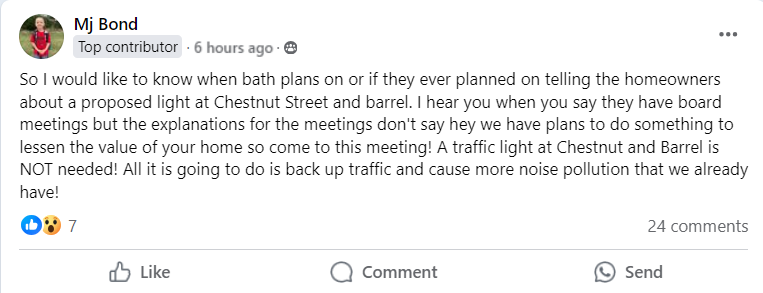
To suggest or imply that Bath secretly ‘plans on or if they ever planned on telling the homeowners about a proposed light at Chestnut Street and [Barrall]” could have been cleared up by just calling the Borough Office, then reporting those findings on social media. Or continue to criticize, either way. What’s wrong with calling first?
There are NO plans at this time to install a traffic signal at the intersection of Chestnut Steet and Barrall Avenue. Bath hasn’t planned or proposed a traffic light at N. Chestnut St and Barrall Avenue. It’s unnecessary to suggest otherwise.
The Bath Planning Commission has recently reviewed a sketch plan that would redevelop the PNC property into a convenience store with refueling station. The site could host a major regional convenience store refueling station combo. As part of the development process, PennDOT (not the Borough) may require additional traffic control elements and redevelopment of the block by the applicant. None of this has been fully worked out or approved at this time. It’s also possible PennDOT may not require another signalized intersection. It is too early to jump to any conclusions about the site development, or new traffic signals, and what may or may not transpire with the project. This is why if you hear something, doesn’t sound quite right, call or stop by the Office.
The public is welcome to attend Bath Planning Commission meetings, which are held on the 3rd Monday of each month beginning at 6:00 PM.
22 – Michael Long Misinforms Commentor, David Vreeland under Bath Community Hub | September 3 Post Show Me the Money Trail
Comments are misinformation.
The comments:

Michael Long Point #1 – Over the course of three years the mayor sporadically missed insurance premium payments due to error. A full review of the missed payments, payments received, along with matching up corresponding invoices and bank statements prove the problem was corrected. The Borough was reimbursed, in full, for the mayor’s healthcare insurance premiums. See Notable Statements of 2022 Item #9 for more information.
Mr. Long has recently suggested the checks issued by the Mirabito’s were fraudulent, without providing any proof. (Mr. Long has claimed in emails to Borough Council he has used an online forensic check scanning program to prove the checks are fraud.) However, Mr. Long discounts, in his possession, he has the Borough’s General Fund bank statements, proving the Mirabito checks were in fact cashed, consistent with the billing, including the back payment over the course of time the Mirabito’s were purchasing health insurance from the Borough.
Mr. Long, the Bath PA Community Hub Facebook Group and its administrator associates continue to write and publish knowingly false information with malice. The Borough has a library of such incidents contained on this webpage, and also under Notable Statements of 2022, and Notable Statements of 2023.
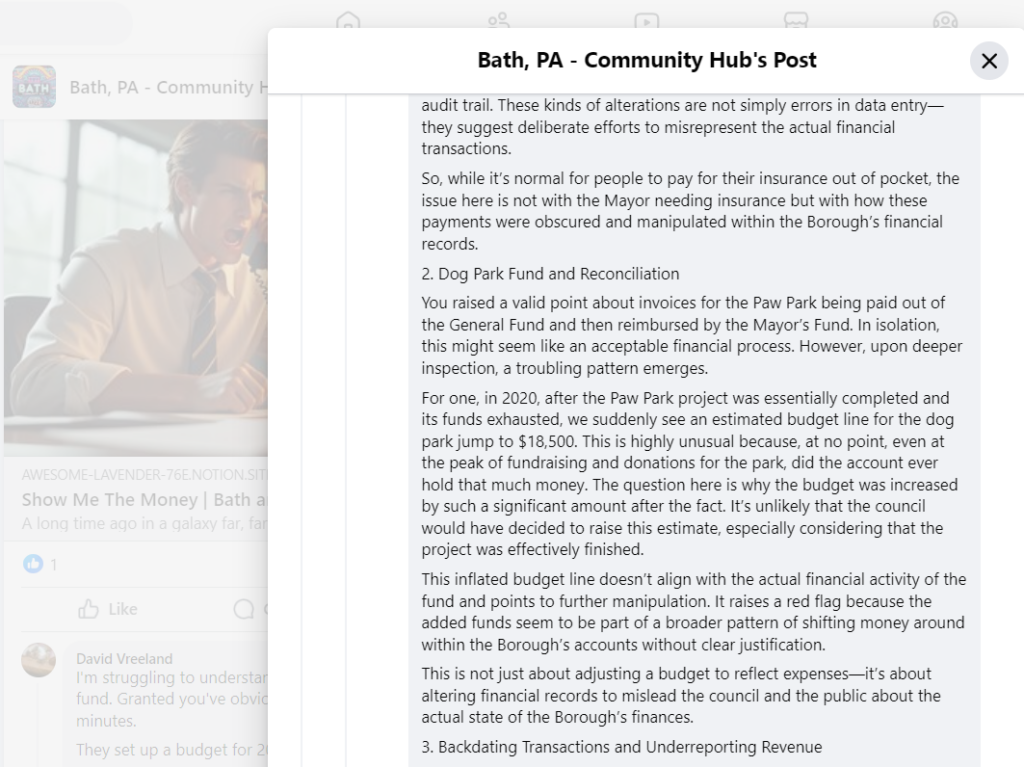
Michael Long Point #2 – This is a consistent conflation of data by Mr. Long. The All-Funds report for the mayor’s fund may not align with the mayor’s fund reconciliation report. The All-Funds report is simply an estimate on accounts and where the Borough believes the accounts may be at different points in time. The All-Funds report has no bearing on budgetary decisions that Borough Council makes. The mayors fund has no bearing on the General Fund or “financial health” of the Borough. Point #2 doesn’t prove wrongdoing or fraud of any kind.
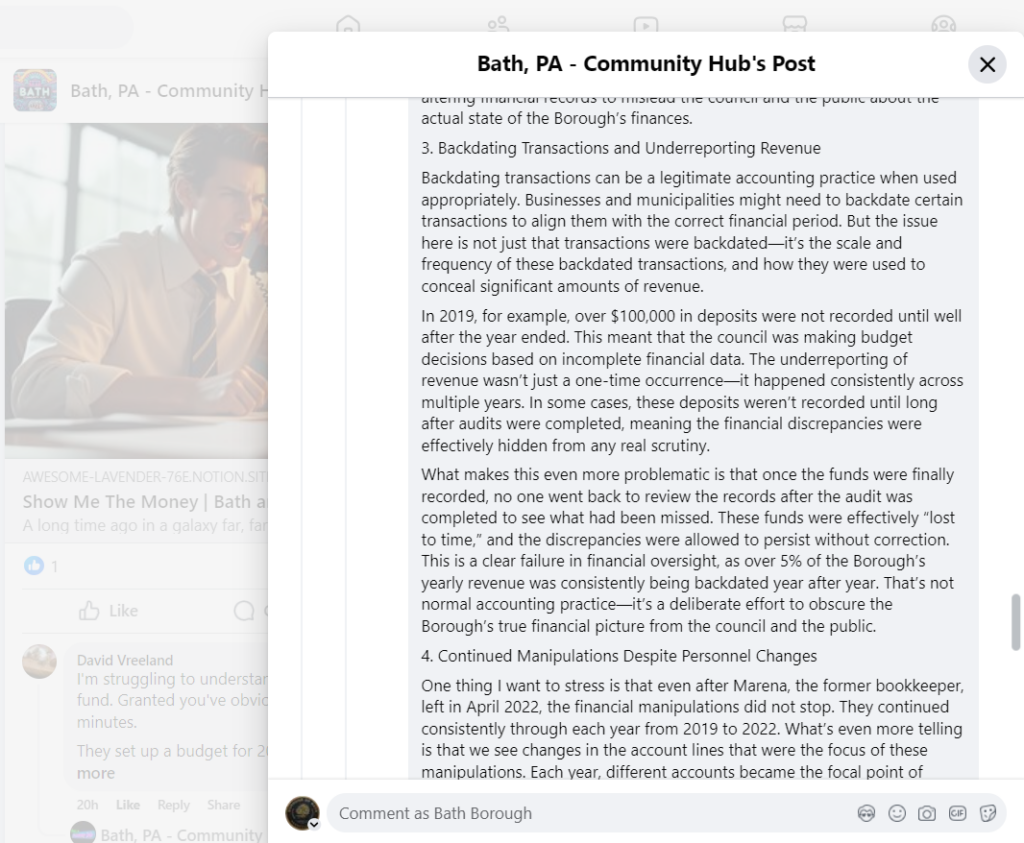
Michael Long Point #3 – Backdated transactions do occur. Bath’s previous bookkeepers handled nearly 30 accounts per month, while trying to complete other customer service and Borough operational tasks, and/or projects handed down from Borough Council, in addition to receiving tasks from Manager Flynn to complete. There were times when account reconciliations extended beyond 3 months for various reasons before accounts could be caught-up. There were no “hidden” or “obscure” cover-ups to misrepresent the Borough’s financial picture. Nothing in the record suggests, at all, the financial data entries were a deliberate effort to obscure the Borough’s financial picture, and this post doesn’t provide any evidence to support the claim that it does.
Manager Flynn uses 3- and 5-year budget averages to estimate a current year Budget. While true, it’s best to have all financial entries in the General Fund in the last year of an upcoming years’ budget estimate, sometimes this isn’t fully complete until mid-year of a current year or after the audit is complete. Nor is this a fatal mistake. Mr. Long fails to understand that Bath’s yearly budgets are still based on a number of other factors that lead to reasonable estimates. To include using Budget data from previous years that are closed through the audit process.
Bath has adopted recent policy that states all of Bath’s bank accounts (which can be between 25 and 30 accounts, all with varying activity) must be reconciled to within the closing month. This was always an issue in Bath dating back prior to Manager Flynn assuming oversight of the Borough’s bookkeeping. Since Bath has hired a professional bookkeeper (solely focusing on bookkeeping–no other outside operational distractions), there have been no issues with reconciling its accounts on a timelier basis than in previous years.
Michael Long Point #4 – Opinion and there is no basis to form a belief there were manipulations despite personnel changes.
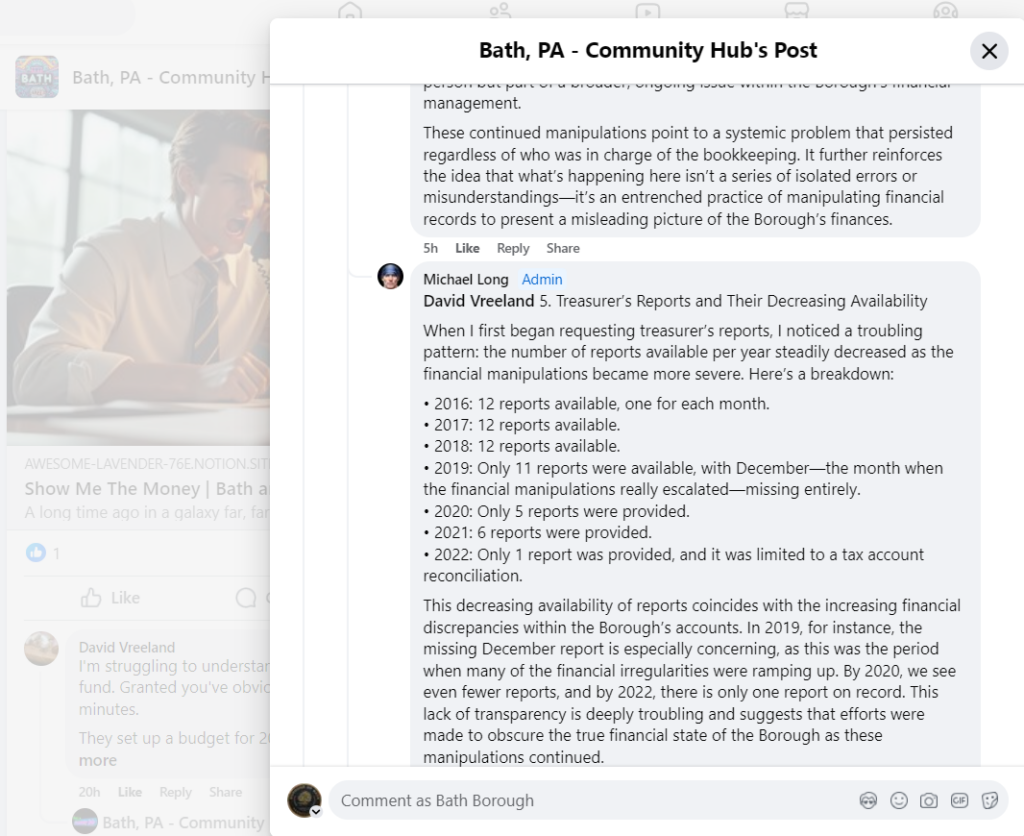
Michael Long Point #5 – Mr. Long fails to realize the time period he highlights was during Covid-19. Bath, like many communities, were managing through the crisis. In addition, and prior to Covid-19, Treasurer Reports were never formatted and standardized until May 2023. Over the years, as Borough Council has changed and asked for different items to be included with the Treasurer Report, the report, and its contents/arrangement was all subject to change prior to May 2023.
Mr. Long points out a discrepancy in the Treasurer Report availability over the Covid-19 period, but then fails to report on Treasurer Report consistency going forward from May 2023 to current, all publicly accessible on the Borough’s website. Mr. Long also fails to provide a contrasting opinion that some of the bank entry issues and missed Treasurer Reports were attributed to outside circumstances.
Mr. Long also makes a logic fallacy of jumping to a conclusion (provides faulty reasoning); unable to inform readers how the decreased availability of the Treasurer Report relates to fraud or financial mismanagement of any kind. Mr. Long simply compares issues of similar likeness and posits the result must be fraud without considering any other information.
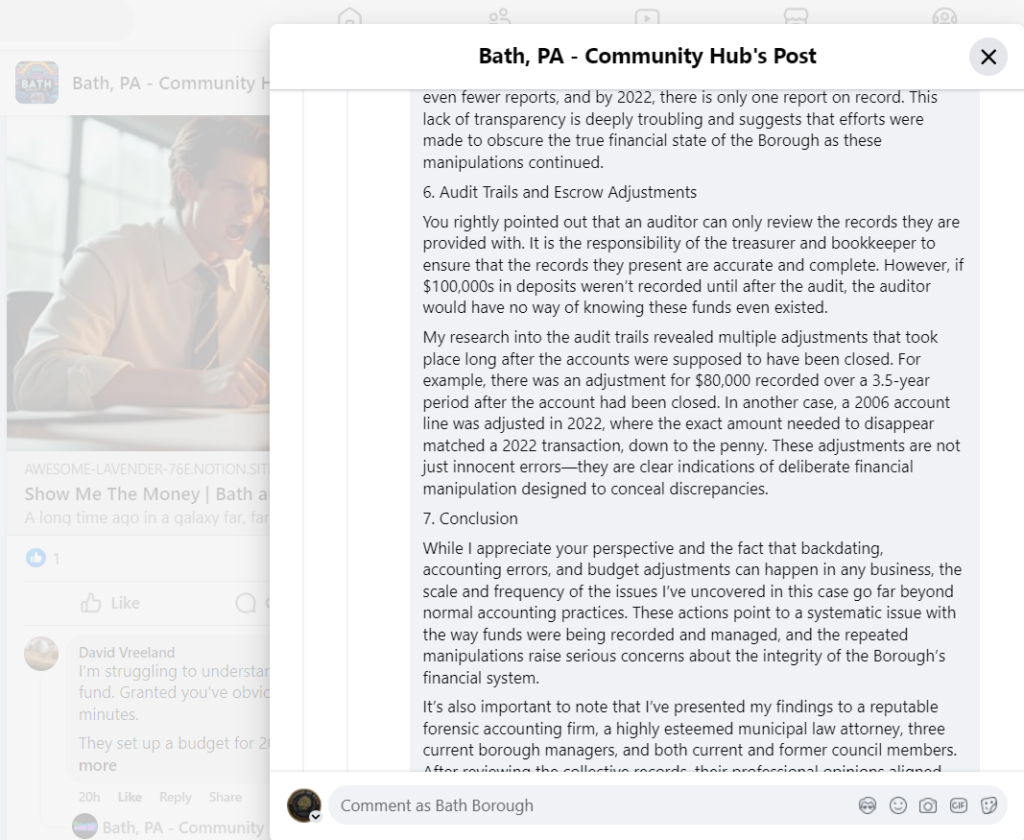
Michael Long Point #6 – Mr. Long is assuming there were $100,000 in deposit entries made (and there may have been) after the closing year and after an audit occurred. Where the comment is FALSE. First, Mr. Long does not provide any evidence that there were $100,000 in deposits made. More importantly, Mr. Long doesn’t share, if deposits were, in a sense, caught-up for account reconciliation purposes, were made prior to the Borough’s audit of the financial period the deposits belonged. The audit would have NEVER occurred if the account reconciliations for the subject audit period were left open and unfinished.
Michael Long Point #7 – Nothing in Mr. Long’s dissertation supports evidence that there is a systematic issue with the way funds were being recorded and managed.
Mr. Long goes on to state, “I’ve presented my findings to a reputable forensic accounting firm [unlisted firm], a highly esteemed municipal law attorney [firm and lawyer unnamed], three current borough managers [all unnamed from unknown municipalities] and both current and former council members [unnamed– and quite possibly also involved with the heinous crimes Mr. Long seeks to uncover!].
This paragraph may seem authoritative and really puts an emphasis on just how (allegedly) bad the situation in Bath is financially. After all, Mr. Long is saying he spoke to these ambiguous “authorities”, and they say Mr. Long’s opinions are correct. But Mr. Long can’t back up his claims, so he resorts to an appeal to authority. This paragraph in particular is a classic appeal to anonymous authority, which is an appeal to authority that doesn’t attribute the claim to any specific person. Rather, the arguer attributes it to an unnamed individual or, more commonly, group of individuals.
Appeals to anonymous sources are more often than not, a way to fabricate, exaggerate, or misrepresent facts in order to deceive others into accepting a claim. If not for the history of Michael Long and the library of mis/disinformation cataloged by the Borough, it may have been passed off as a form of subconscious deception.
Mr. Long has been deliberate in his approach because he’s already spoke on the record with WFMZ 69 News, stating he has zero accounting or background in finance. Mr. Long himself isn’t qualified to speak on the financial condition of the Borough, let alone give his investigative findings of what he deems is financial mismanagement, fraud, embezzlement, or any other claims he’s made about the Borough, all without evidence. But he did speak to some ‘experts’…
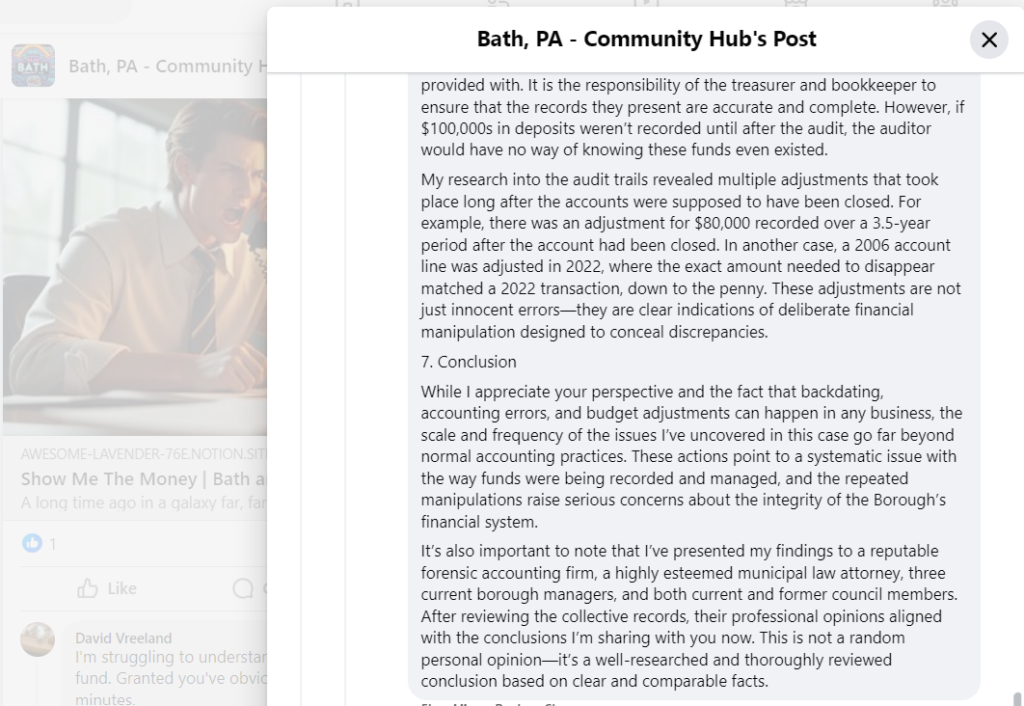
Michael Long Point #7 Cont’d – Mr. Long states, “This is not a random personal opinion– it’s a well-researched and thoroughly reviewed conclusion based on clear and comparable facts.” Hysterically FALSE. Mr. Long provides his pure bias, slamming and falsely accusing the Borough of fraud or financial mismanaged (for roughly 2 years now) at every turn without an understanding of the internal financial workings of the Borough. All while never pointing out Bath’s financial successes, low borrowing rate, the fact that Bath has created its own Capital Improvement Fund (something it has never in history, has to the extent it does today.)
At no time has Mr. Long provided readers with ANY comparable data, such as reviewing all of Tatamy’s financial records, or any other Boroughs similar in size to Bath’s operations and accounting practices over the same time period to determine if Bath is any different or very similar to a wide variety of small town’s accounting practices. Mr. Long’s reporting should include hard and fast facts comparing Bath to several other municipalities, across many different comparable funds, financial reports, and bank accounts. Mr. Long’s report doesn’t do this. Instead, it singles out only Bath and absolutely does not conclude anything based on clear and comparable facts.
21 – Another Report by the Bath Community Hub & Michael Long Misinforming Bath’s Public | September 3 Show Me the Money Trail
Report contains MISINFORMATION & False Claims.
The Report obtained from the Bath Community Hub:
The report indicates “Let’s begin with a page from the 2019 Preliminary Budget”. The report is showing the Borough’s “All Funds” snapshot, and not a preliminary budget. Michael Long and the Bath Community Hub have consistently misrepresented preliminary budgets, all fund snapshots, Profit vs Loss, and General Fund Actual vs. Budget reports. The “All Funds” report is simply an estimation on funds held across Borough accounts. It is not meant to be interpreted as the Borough’s preliminary budget.
The Mayor’s Fund is a separate, non-developer escrow fund, used to hold funds related to the mayor’s community projects and events. The Mayor’s Fund has nothing to do with the Borough’s General Fund. These are two separate funds in two different bank accounts.
The report attempts to rehash the Mayor’s Health Insurance premiums repayments. This issue has been settled. For a breakdown of repayment activity from the mayor, please see Notable Statements of 2022 – Item #9.
The report conflates, as Michael Long has done so many times in the past (See Notable Statements 2022, 2023, and 2024), Mayor’s Fund data with the Borough’s General Fund data. Michael Long draws connections between similar dollar value amounts between funds in an effort to conclude fraud or wrongdoing that cannot be inferred in reviewing the data he claims to be proof of his findings. Michael Long’s misunderstanding of the records he obtains from the Borough does not constitute fraud or financial mismanagement on the Borough’s part.
The report inappropriately suggests and widely jumps to conclusions that QuickBooks entries that show corrections to line items is somehow fraudulent, which isn’t the case. Corrections to line items and accounts may occur throughout an account’s life cycle.
The report highlights a cleared check from the General Fund, check #16936 in the amount of $178,304.01 dated 08/21/2019. This check was payment to New Enterprise Stone for a 2nd drawdown on the Washington Street reconstruction project. The report attempts to make, although senseless, a connection of the Washington Street reconstruction project drawdown and the mayor’s health insurance reimbursements.
The mayor, as the report indicates, was eligible and legally authorized to engage in the Borough’s Health Insurance program. The reason for doing so is because it does make perfect economic sense for the mayor, or any member of Council that may need health insurance, to purchase health insurance from the Borough’s shared pool. It means lower overall healthcare package premiums. The mayor or member of Council can take part in the Borough’s health insurance as long as that member pays their monthly premium.
For reasons stated above, the rest of the report misuses Borough records and data to support a position of mismanagement and/or fraud upon which there is absolutely no evidence to support such claims.
20- On August 30, 2024, Michael Long of the Bath PA Community Hub Post | Mr. Long’s Assessment of the Recent Motions Hearing
Post contains MISINFORMATION & False Claims
The post (highlighted for discussion):
Subject #1 – “Annoyed by their desire to waste my time I clearly filled in the memo line with my response to the 2nd untimely response.” This statement is mischaracterizing the Court Order. Bath’s first two petitions were not dismissed for being untimely. Micheal Long is confusing a Court’s decision to dismiss something as moot compared to dismissing something as untimely. Bath’s first two petitions were dismissed as ‘moot’, even though the issue of mootness was never an argument made before the Court.
When the Court dismissed petitions #1 and #2 as moot, it is because the Court found no practical value in those petitions, not because the petitions are untimely. If the Court found the petitions were untimely, it would have ruled and dismissed the petitions as untimely. That didn’t happen here. This is because the Court recognized OOR did reconsider its Final Determination that prompted Bath’s petition #1. Bath’s Petition #1 includes three arguments where OOR erred in their Final Determination.
OOR agreed to reopen and would later settle 2 of 3 issues. Bath’s arguments were generally: (A) the issue of Mr. Long changing his request on appeal, which isn’t allowed under the Right-to-Know Law, and (B) while changing his request on appeal, and OOR inappropriately accepting that position, it expanded the scope of records on appeal other than what was originally requested. Finally, issue (C) involves the release of attorney-client privileged emails containing only purely factual information.
Important note: Bath had no choice but to file petition #1 because of its appeal deadline. Prior to filing its petition, Bath did send a letter to OOR requesting a reconsideration of their original Final Determination because OOR made mistakes. Bath’s request for reconsideration included the three arguments above, which were inseparable. Bath was unsure that OOR would even grant reconsideration (its rare OOR reconsiders their final determinations).
However, OOR did file a partial grant of reconsideration within a matter of a half hour of the Borough’s filing of petition #1; this all occurred on December 1, 2023, the last day, both, Bath’s appeal and OORs reconsideration could have been filed. OOR only granted a review of arguments (A) and (B), but it denied (C). So, by filing petition #1, Bath’s third argument was preserved.
Then, as OOR did grant partial reconsideration to hear arguments (A) and (B), Bath contends the “partial” reconsideration was statutorily unauthorized. OOR even asked Bath if the County petition should take jurisdiction. Bath replied that OOR relinquished jurisdiction. OOR disagreed.
The rules governing requests for reconsideration state to either “grant” or “deny” reconsideration, but not both. OOR has only recently started this business of piece-meal grants of reconsideration, something it had never contemplated prior to 2023. Had Bath delayed filing petition #1 past the December 1, 2023, deadline, then its appeal rights, including arguments (A), (B), and (C) would all been waived. While Bath contended OOR lacked jurisdiction after petition #1 was properly before Court, and Bath contended OOR didn’t have the statutory authority to issue a ‘partial’ grant of reconsideration, argument (C) remained denied and in need of preservation. OOR pushed forward with reconsidering Bath’s first two arguments. This is what prompted petition #2 to be filed.
On January 12, 2024, OOR issued its Final Determination Upon Reconsideration. OOR’s position is that an agency needs to review attorney-client privileged emails and release purely factual information. This position violates the attorney-client privilege doctrine. Bath filed petition #3. Preserving its third argument.
The Court felt that since OOR granted Bath its arguments of (A) and (B), why rehash the first two petitions. Therefore, petitions #1 and #2 added no additional value. Since 2 of Bath’s 3 arguments were settled by OOR, favorable to Bath, the remaining third argument is open and before the Court. The Court noted, “judicial economy [does] not favor piecemeal review.” The Court simply cleaned up the docket. Fair enough. Except for two problems. One problem is created as discussed under Subject #2 below. And the other problem remains unresolved, where Bath loses its right to challenge OOR’s abuse of discretion concerning partial grants of reconsideration. That’ll have to be a fight for another day and another agency covered under the Right-to-Know Law.
The Court paved the way to argue petition #3. Preserving Bath’s main focus with combing through matters concerning attorney-client privilege for purely factual information, which has never been the law. It is very possible Michael Long will perpetuate this record as he has done in previous proceedings.
Bath is scheduled to have pre-trial conference in September. Michael Long will be invited to this conference, to discuss with a Judge. Bath expects shortly thereafter briefs will be submitted to the Court to have this remaining issue (Argument C) concluded in a few months.
Subject #2 “The Borough filed almost 30 separate filings in court tied to just those two appeals.” Michael Long is completely ignoring and fails to share with his audience the real reasons behind the Borough submitting those filings. It was a direct result of Michael Long’s improper Motions filings that prompted a Motions hearing in the first place. Otherwise, Bath could have consolidated the petitions and filed for argument to resolve the matter. Michael Long added this Motions step to the process, which was totally unnecessarily and improper before the Court.
Bath’s petitions are petitions for statutory review. In other words, asking a Judge to review the facts and see if OOR misapplied rules. This isn’t a civil lawsuit for monetary damages. Michael Long thinks it is, gumming up the Court by filing Motion after Motion, citing irrelevant appellate and civil litigation procedures. Motions that contained non-existent case law or where Long uses case law that didn’t support the legal argument(s) proposed. None of those Motions were properly before the Court.
When Long was confronted on this issue during the June 10th Council Meeting, Long even acknowledged he was wrong–saying “people make mistakes.” It isn’t just a mistake when Mr. Long is forcing the amount of taxpayer money to address his misconduct. Even when Mr. Long was warned repeatedly about his intentional mis-filings. In fact, in the end, the Court provided footnote #2 in its Order, relaying Mr. Long’s Motions were procedurally improper, and Bath’s Motions would have been granted had not the Court found the issue moot.
While true, the Borough expended a great deal of resources to review, prepare, and argue these frivolous Motions by Michael Long, where he attempts to reframe these “30 separate filings” by the Borough to be a stalling tactic, does not change the fact that Mr. Long is responsible for each action. Mr. Long was welcome to file a response to Bath’s petitions. But under no circumstance did Mr. Long have a basis to file numerous Motions, which were labor intensive for the Borough to review and respond.
The Court, unfortunately, has given Michael Long a pass. Bath was requesting, in its Motions of the two petitions that were dismissed as ‘moot’, to sanction Mr. Long and to have him repay Bath’s taxpayers for his frivolous misconduct, forcing a ridiculous Motions hearing. A situation Michael Long created, and not Bath Borough.
Mr. Long is also failing to share that petition #3 is active and that Bath has prevailed on its Motion to Quash Mr. Long’s Cross-Appeal. The Court found and dismissed Mr. Long’s Cross-Appeal was untimely.
Subject #3 – “This is the type of thing the Borough has been doing the entire time.” Michael Long leaves out important details of his own ill will and that, at the end of the day, he has been driving this bus. Bath has attempted, on more than one occasion to settle the court issues, respond to records requests outside of the Right-to-Know Law, and attempted to educate Mr. Long on the documents he’s retrieved. All to no avail. Mr. Long is not being truthful about his role in this or any of the Right-to-Know matters.
Subject #4 – “Did you know that the cost the Borough claims I found hard to believe so I filed a RTK request for those figures and answers…” While true, Mr. Long has requested (and received) Borough invoices from Stevens & Lee regarding the costs associated with his conduct, the description field of the work provided by the Solicitor’s Office was redacted under the Right-to-Know Law. OOR agreed with the Borough’s redactions because the description field contained attorney-client privileged information. Here again, Michael Long fails to acknowledge that he does have the invoices with the value of the work provided. It also doesn’t change the fact that the Borough has spent an enormous amount of money through, not only legal, but IT, auditing, and bookkeeping trying to handle Mr. Long’s unreasonable records requests (see this webpage for more information). Mr. Long is also shirking his responsibility as to why the legal fees have increased due to his inappropriate court filings.
19 – On August 29, 2024, Michael Long publishes another report entitled, “Dearest Bradford” to the Borough of Bath Facebook page, under the “Truth…spread it on” post.
Report. Opinion. Partially True. Partially MISINFORMATION.
The Report “Dearest Bradford”:
This discussion will not cover all sections of the above report.
Partial truth, generally MISINFORMATION Subject #1 – “The claim that the mayor had no voting power in council decisions and thus could not have had a conflict of interest in recommending her husband for the vacant council seat is demonstrably false.” While true, the mayor does have voting rights, under narrow circumstances. The mayor cannot vote at meetings except as follows, in accordance with the Borough Code, in pertinent part:
§ 1003. When the mayor may preside over council and vote, attendance of mayor at council meetings and breaking tie votes.
(b) Voting at meetings.–The mayor shall not vote at the meeting unless the mayor’s vote shall, for any reason, be required to effect the organization of council or to elect any officer who is required to be or may be elected at the organizational meeting. If the mayor is absent from the organizational meeting, one of the members of council physically present at the meeting and chosen by the members eligible to vote at the meeting shall preside.
§ 10A07. Duties of mayor.
(c) Veto and voting power.–The president or vice president of council while acting as mayor shall have power to veto a proposed ordinance or the annual tax resolution under section 1302(a) (relating to tax levy) or to break a tie but shall not have power to vote as a member of council.
Because of the foregoing, Mayor Mirabito was ineligible, in no way could she have voted, unless to break a tie, for her husband to be seated at the January 3, 2022, meeting. Mayor Mirabito had no voting authority at the January 3, 2022, Council Meeting because the question of filling Mark Saginario’s vacant seat was before a majority of Council. Council voted in the majority to seat Emanual Mirabito as required by the Borough Code’s Council vacancy regulations. Vacancy regulations only impose a timeframe for which the seat must be filled.
MISINFORMATION Subject #2 – “The mayor’s involvement in advocating for her husbands appointment…” Taken further, the mayor or any member of Council that may have expressed an opinion on the issue whether in their official or unofficial capacity does not disqualify the Councilmember from voting on the issue before Council. Borough Code, in pertinent part:
§ 1001. Organization of council, quorum, participation by telecommunication device, voting, compensation and eligibility.
(d) Voting.–A member of the council shall not be disqualified from voting on any issue before the council solely because the member has previously expressed an opinion on the issue in either an official or unofficial capacity.
MISINFORMATION Subject #3 – [Relative to the ‘Court’ issue] “Only to have the first two be premature, but that hasn’t stopped you from letting those lawyers keep filing more and more paperwork into cases that are DOA.” This statement is a mischaracterization of events and false.
Here is an overview of the Court Order (see also Notable Statements of 2024 – Item #20 above):
On August 28, 2024, the Northampton County Court of Common Pleas has issued its Court Order following the motions hearing on August 20th in this matter. The Court has decided Bath’s first two petitions for review are dismissed as ‘moot’. The Court also decided Michael Long’s Cross-Appeal has been Quashed as being filed untimely. Bath’s third petition for review can move forward for a hearing.
Bath’s third petition argues the Right-to-Know Law does not authorize the review and the public release of attorney-client privileged emails for purely factual information.
Bath is set to have a pre-trial conference on the third petition in September.
Bath’s first county petition (Docket No. 2023-09734) appealed the OOR Final Determination issued November 3, 2023 (OOR AP-2023-1598). Since Bath was required to file its appeal to the county by December 1, 2023, Bath did so. Prior to filing the appeal, Bath did request OOR reconsider its Final Determination. On the last day Bath could file its appeal with the county, OOR partially agreed to reconsider their Final Determination of November 3, 2023. The Court finds that this first county petition is moot as a result, since the Final Determination of November 3, 2023, was reopened on reconsideration. Therefore, it is no longer the Final Determination. Any Motion(s) associated with this first petition (by the Borough or Michael Long) were also dismissed.
In the first petition, there were multiple Motions. The Court noted, “Also at docket number 2023-9734, the Borough of Bath filed a Motion to Strike the Answer, Preliminary Objections, and Counterclaim, filed by Requestor, Michael Long, as well as a Motion to Strike Requester’s Praecipe to Strike Appeal. While Requestor’s filings are procedurally improper, and the Borough’s Motions would otherwise be granted, based upon the above finding that the appeal at 2023-9734 is moot in its entirety, we need not rule on the Borough’s Motions.”
Bath’s second petition (Docket No. 2023-10559) was filed after OOR granted ‘partial’ reconsideration. Bath held that the Final Determination by OOR issued November 3, 2023, was moved under County jurisdiction, since Bath met the filing deadline, and that OOR didn’t have the authority to issue a partial grant of reconsideration under applicable rules. The Court finds that this second petition is moot as well, since the Final Determination of November 3, 2023, was reopened on reconsideration where OOR agreed with two of Bath’s three separate arguments (see above under Synopsis). Any Motion(s) associated with this first petition (by the Borough or Michael Long) were also dismissed.
Bath’s third petition (Docket No. 2024-01039) was filed after OOR issued its Final Determination upon Reconsideration dated January 12, 2024. The Court finds Bath’s third petition has standing and will proceed to hearing. The Court also granted Bath’s Motion to Quash Michael Long Cross-Appeal, as his Cross-Appeal was facially untimely.
18 – Report Issued by Micheal Long August 28, 2024, entitled “Review the Facts” | Posted to the Borough of Bath Facebook Page under Bath’s post “Truth…spread it on” dated August 27, 2024
The Report: MISINFORMATION
Here is the original report:
Here is the report with markup:
Correction 08/29/2024: Under page 5 of the marked-up report, Flynn questioned how Michael Long could make the claim that the product of the calculation contained in Flynn’s letter of May 21, 2024, could equal $640,228.84. A Facebook commentor recognized the mistake made in Flynn’s letter and called it out on the Borough of Bath FB post.
The rate established by the auditors to calculate the debt service property tax is determined by taking 1.25 (millage rate) and dividing by the total property tax millage rate (15), which equals 0.0833333 and not 0.8333333 as stated in the letter. This was a typo by Flynn. The product however, $64,023 is still correct and what’s reported in the 2019 DCED CLGS-30 report, line 392.00. This is determined by taking the rate of 0.0833333 and multiplying by the total tax revenue collected in 2019, which was reported at $768,274.13. ($768,274.13 x 0.0833333 = $64,022.8186 rounded to whole dollars of $64,023) as Flynn has stated all along.
This exchange relates to the choppy logic fallacy. Or simply put, trivial objections. Focusing on trivial details of an argument, rather than the main point of the argumentation. Nothing changes the fact that the auditor’s determination (meaning nothing to do with Manager Flynn or staff data entries) of debt service revenue collected was $64,023 and properly reported on the 2019 DCED CLGS-30.
17 – A report issued by the Bath PA Community Hub “Comprehensive Analysis of the Financial Irregularities in Bath Borough (2019-2022)“
This accordion will contain the report, in one location, issued by the Bath PA Community Hub (the report is unauthored) alleging financial mismanagement and fraud. It may be referenced to in additional sections of this webpage.
This report was provided by the Facebook Group Bath PA Community Hub after that group issued a statement on its public social media pages that Bradford Flynn between 2019 and 2020 embezzled more than $100,000 from the Borough of Bath to purchase two homes. Statement. FALSE. DISINFORMATION. See also Notable Statements of 2024 Item #12.
Contents of Report: Highly opinionated. Partially True. Partially Misinformation/Disinformation. Chapters of the Report may be pulled in separate accordion drop down discussions.
The report:
16 – Statement “Bradford Flynn, between 2019 and 2020, embezzled over $100,000 from the Borough of Bath to purchase two homes.” | Administrator Comment from the Bath, PA Community Hub shared on another Bath, PA Community Hub operated by Michael Long | August 19, 2024. Community Hub comment under Kathy Seigfried | August 24, 2024.
Bath PA Community Hub response to Facebook profile Kathy Seigfried:
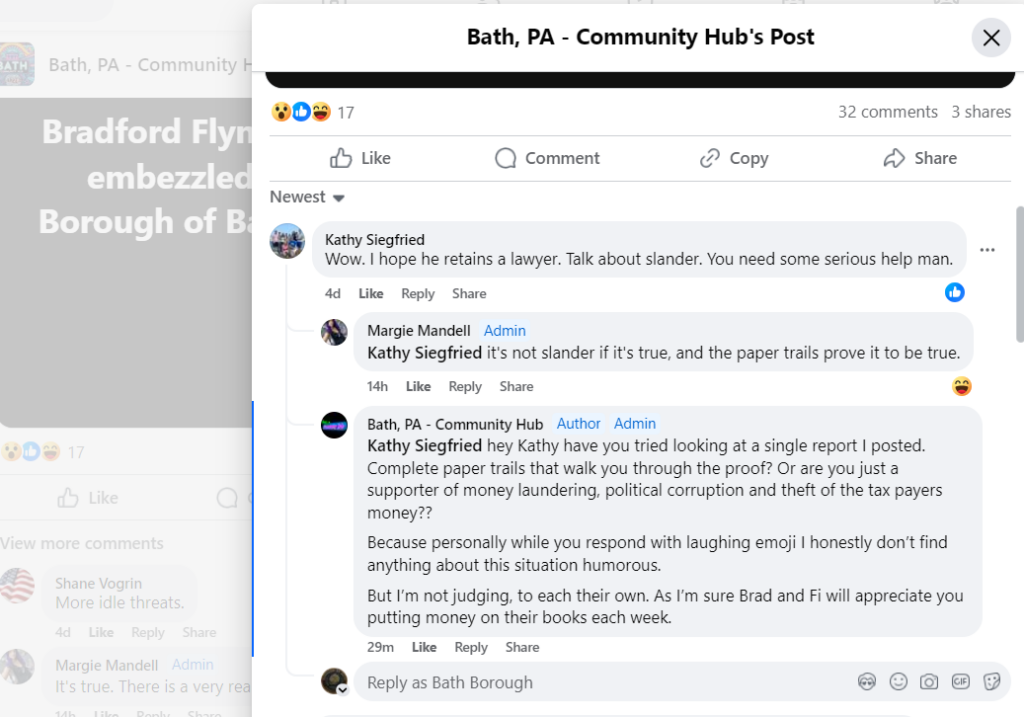
The statement by Bath PA Community Hub “Complete paper trails that walk you through the proof” FALSE. The documentation shared by Bath PA Community Hub is largely, if not completely conjecture and even states that the information provided does not definitely prove any wrongdoing (See Section 1.6 of the Bath PA, Community Hub Report).
This post is also interesting from a logical perspective that readers should be aware. Bath PA Community Hub is resorting to attacking members of the public that disagree with the statements and information provided by the Community Hub, instead of backing up their claims. This is a form of ad hominem: guilt by association (logical fallacy): where attacking an argument by casting aspersions on people or organizations associated with either its proponent or the argument itself.
Here, Bath PA Community Hub writer informs Facebook profile Kathy Seigfried, that if Kathy (or someone else) doesn’t agree with the information or positions taken by the Bath Community Hub regarding their ‘findings’ of alleged crimes, then Kathy (or anyone else) must also be a “supporter of money laundering, political corruption and theft of the taxpayers money.”
This is an especially foolish form of abusive ad hominem– attacking the character of a proponent of the Borough, which is clearly irrelevant to the Bath PA Community Hub’s intent to prove the Borough’s wrongdoing. Bath PA Community Hub should stick to supporting its claims rather than insulting its patrons. It’s a clear indication that Bath PA Community Hub is losing its arguments, which is why someone would go on a personal attack.
It’s also interesting, both Bath PA Community Hub groups (operated by Michael Long) support, “enabling each member to draw their own conclusions and form their own opinions” and the group’s desire to “encourage robust yet respectful debates and hope this group will serve as a valuable tool that, until now, has not been provided in an all-inclusive or readily accessible manner” except that is, as evidenced in the post above, when someone dissents or disagrees with the groups content.
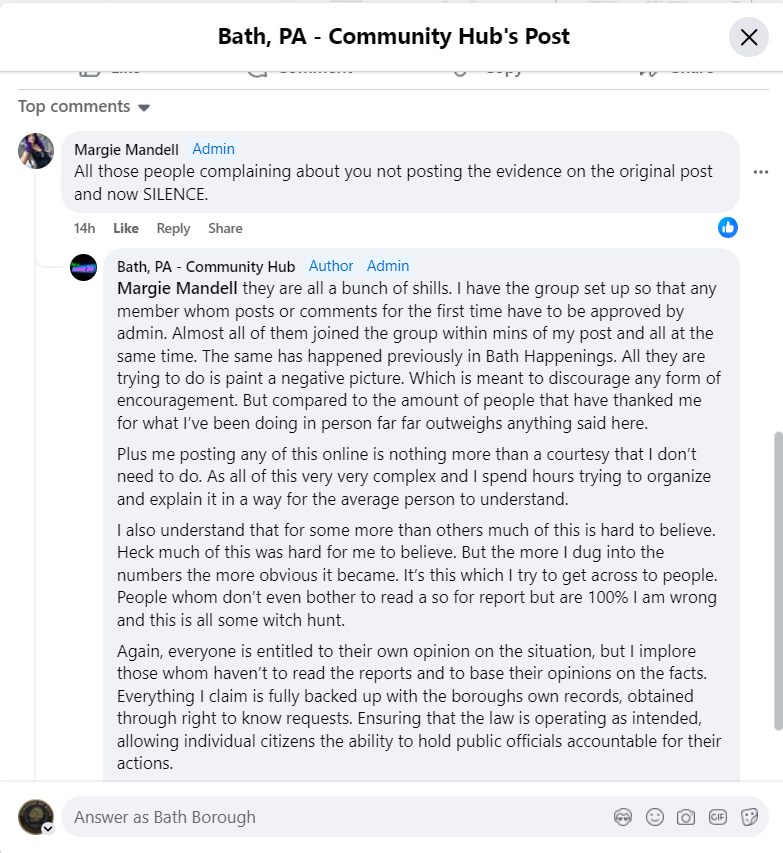
The Bath PA Community Hub is entertaining the screening of certain comments from public participants, filtering out positions on debate, which is exactly the opposite of what the Facebook group(s) says its mission is. See follow up post by Bath PA Community Hub to its own post, again calling out anyone (naming them “shills”) who don’t respond to the groups position that there is massive fraud afoot within the Borough of Bath’s government upper echelon. And apparently comments must be “approved” (at least initially) before being posted to the groups page. It’s a public forum that isn’t so open to public ideas or thought. This is not a free and fair method of debate.
15 – Statement “Bradford Flynn, between 2019 and 2020, embezzled over $100,000 from the Borough of Bath to purchase two homes.” | Administrator Comment from the Bath, PA Community Hub shared on another Bath, PA Community Hub operated by Michael Long | August 19, 2024. Community Hub comment under Richard Williams | August 23, 2024.
Statements/Postings in General. False and MISINFORMATION.
The posts by the Bath Community Hub, following up to a comment made by Facebook profile Richard Williams:
The follow up posts were extensive and there are highlighted areas that will be addressed. Large portions of the Community Hub’s posts are opinion-based or are in no need of further response.
Highlight #1 – In December 2019, Brad stole $93,452 to purchase his girlfriend’s ex-husband’s half of a home. Later, in March 2020, he used the same money to buy another half of the home, as he needed the funds for down payments and taxes. Notably, the mayor benefited in 2019 by redirecting dog park funds to cover her insurance costs. This pattern continued until 2022, when they used other funds from that year. FALSE. There is no evidence Manager Flynn stole $93,452 to purchase his (at the time) girlfriend’s ex-husband’s half of a home. Nor has the Bath PA Community Hub provided evidence of the embezzlement. The Borough’s financial records speak for itself.
Flynn’s girlfriend, at the time, had finalized a divorce settlement with her ex. While the following is not subject to disclosure, it is provided in brief in the interest of transparency (Manager Flynn voluntarily provides the following): As part of the Gower vs. Gower divorce settlement, the home that Flynn’s girlfriend occupied at the time of their separation (and since 2006) was assigned to her. In December of 2019, Flynn’s girlfriend completed a refinancing, to remove her ex-husband from the deed and mortgage, per their divorce settlement agreement. Flynn did not purchase the house with his girlfriend; however, Flynn was added to the deed during refinancing since he was living with her at that time. There wasn’t a sale agreement between Flynn, Flynn’s girlfriend or her ex-husband.
Then, in March of 2020, Flynn and his girlfriend sold the house in Hanover Township, Northampton County to purchase a home together in Plainfield Township, where they currently reside.
The mayor did not benefit from redirecting dog park funds to cover her insurance costs. This statement is patently false, and the writer provides no evidence of this claim. The Borough’s financial records speak for itself.
Highlight #2 – In October 2021, Mark Saginario was hired as the Tatamy Borough Manager. He arrived on October 4, 2021, but he was late for the Tatamy meeting, which coincided with the borough’s meeting. He was officially hired at that meeting and informed the council of his resignation when they were in executive session. First, this part of the post is hearsay. The writer claims to be sharing information, allegedly obtained from Mark Saginario (or wherever), and information discussed in Executive Session with either Tatamy’s Borough Council or Bath’s Borough Council, which would be a violation of the Sunshine Act.
Mark Saginario filed his resignation from Bath Borough Council in a resignation letter dated December 31, 2021. It does not matter when Mark Saginario submitted his letter of resignation. What matters is that Bath Council accepted Saginario’s resignation on January 3, 2022, which then, at that point, created a vacancy on Council. Writer even provides readers with the Borough Code section regarding the filling of a Council vacancy but rejects the actual text of the law to support an incorrect hypothesis or to allege illegal activity.
Highlight #3 – However, it’s worth noting that these conversations were procedural or factual in nature and cannot be covered by attorney-client privilege. This point was initially raised in my initial right-to-know request, and I was dismissed by the lawyer as being mistaken because it wasn’t the law. Fortunately, I was proven correct. FALSE. The entire statement is false and misinformation. The writer has not been proven correct, despite what the writer is saying. There has been no court decision on the issues discussed by the writer.
Highlight #4 – In addition to my request for the resignation letter of Marena Rasmus, which the borough also denied. Writer fails to explain that personnel matters are not subject to public access. Further, Manager Flynn, in a public email accessed under the Right-to-Know Law by Michael Long was given an email dated April 4, 2022, stating the following: “Unfortunate news: Marena Rasmus has resigned from her position with the borough, effective Sunday, April 3rd. Marena is facing personal issues that has led her to this decision. Sad situation. We wish her the best.”
Highlight #5 – The emails suggest a clear conflict of interest and nepotism. As you read through the email chain you’ll notice that they believe they know better than residents and don’t want the seat to come up in the election. FALSE. The writer fails to demonstrate and provide evidence that a conflict of interest and nepotism occurred.
The mayor can email Council with her thoughts and opinions as she chooses. The mayor can recommend her husband (who was a prior Bath Council person for 12 years, serving 10 of those years as president) to fill a Council seat vacancy. The seat to be filled, once a vacancy was created by Council accepting Mark Saginario’s resignation, was not up for an election despite what the writer claims. When a Council person resigns, this doesn’t mean Council holds an election. Council is only responsible for appointing a new resident to serve out the remaining portion of the resigning members term and within 45 days of the vacancy being created. In this case, Borough Council filled the vacancy created by Mark Saginario within 45 days, and publicly voted on the matter during a public meeting in lawful session.
Nepotism: Is favoritism (as in appointment to a job) based on kinship. This isn’t a scenario where the mayor instructed the Borough Manager to hire her husband to become the new Public Works Crew Leader. This is an example of nepotism.
Conflict of Interest: Is a conflict between the private interests and the official responsibilities of a person in a position of trust. The mayor recommending her husband (who is more than qualified to assume an open Council seat) as a potential candidate, where the mayor has no vote to decide the issue, does not rise to a bonafide conflict of interest. However, assuming the argument: if for example, the mayor was in the position of Council President, where the Council President does have a vote on the matter, this could constitute a conflict of interest. As Council President in that circumstance, she should abstain from discussing the matter and/or voting on appointing her husband to fill an open Council vacancy during a public meeting. In this example, declaring the conflict and filing an abstention letter with the meeting minutes, doesn’t mean the member can’t make a recommendation on the issue.
A clearer example of a conflict of interest occurred when former Council President Mark Saginario offered Council his former spouse at the time for the position of Bath Tax Collector. Saginario was clear to make the recommendation. This was an example where Mark, as Council President, would benefit from his spouse becoming the Borough Tax Collector because the position is paid– there is a private interest and an official responsibility. Further, as Council President, Mark could vote for his spouse to fill the role, which could be challenged as a conflict of interest. However, during this time, Mark appropriately abstained from the discussion, and he abstained from the eventual Council vote to appoint his then spouse Bath Tax Collector. Mark’s abstention letter was placed on the record and attached with the meeting minutes. Here again, it doesn’t mean that Mark cannot make the recommendation to Council that his spouse could serve the role of Bath Tax Collector.
Highlight #6 – The same Brad who prepared these documents requested under RTK, and three if you understand that they were embezzling because they were the mayor’s responses at 4 a.m. makes it obvious that she was concerned about not having someone she could trust or control in that seat. As to Manager Flynn committing the alleged offense of embezzlement, FALSE. The writer has not provided any evidence Manager Flynn has committed the offense of embezzlement.
Highlight #7 – I handled their insurance claims and publicly criticized them for not turning over the checks she wrote for the payments. They even went as far as to edit original documents, which is a form of fraud. FALSE. Writer asserts, without proof, the Borough altered documents relative to the mayor’s health insurance premiums. The Borough has not altered any of the mayor’s reimbursement checks that paid her insurance premiums from 2018 through 2022. The Borough, on numerous occasions has provided factual evidence of the mayor’s health insurance reimbursement to both Michael Long and the public. There is nothing in the record to debate further on this issue. See also “Notable Statements of 2022 – Item #9.”
Highlight #8 – I was able to prove it. The email chain was exported from Outlook on April 28, 2023, and then on May 4, 2023, it was modified using the Aspose LTD library in Visual Studio. FALSE. The Borough has not modified any email chains turned over to the writer (Michael Long) unless provided by law. Emails may have been pulled from a sequence chain due to attorney-client privilege and/or redaction purposes. Writer does not provide any proof of specific emails modified as alleged to obscure any activity.
Highlight #9 – So, to answer your question [Williams: What happened in court today? Hello. Crickets!!!!!], if the borough had any chance of success, they would already have three new YouTube videos. The judge saw right through their lies, and the borough attorney is considered the top RTK lawyer in the state. He literally wrote the book on this subject, and this is an outcome that the current solicitor is fully aware of. That’s why he suddenly decided to leave municipal law. The borough is interviewing replacements for the solicitor at their next meeting. FALSE. Bath’s August 20th, 2024, court proceeding was a motions hearing. Bath was forced into the position to argue motions because of Michael Long’s unnecessary motions that do not apply to the issues at hand, are inappropriate before the court, and were filed with content that is untruthful (using case citations that either don’t exist or do not stand for the legal propositions stated).
At the August 20th motions hearing, there were five (5) motions in total, across three (3) petitions the court will consider. The judge in this matter is not likely to provide a decision as to the motions for another 30 to 45 days. Once the motions are cleared, the Borough will continue with the question in court of whether the Office of Open Records (OOR) abused their discretion and whether OOR failed to follow applicable rules. During the August 20th hearing, the Borough offered to consolidate the cases into one docket number, to streamline the process, and reduce the amount of work on the case. Michael Long declined. This will further protract the matter and cost Bath’s taxpayers even more than it would have if the case could be consolidated.
Also, Bath’s current solicitor is resigning from Bath to spend more time with his family after 20 years of practicing municipal law and has nothing to do with Bath’s current Right-to-Know Law cases in Northampton County Court.
Highlight #10 – On top of that, they manipulate data in a way that makes something complex almost impossible to track. They keep creating new bank accounts, only to use them to further obfuscate the situation, where no new accounts are actually needed. FALSE. Bath has not illegally manipulated any of its financial transactions. The writer claims, without proof or any supporting examples, that the Borough has manipulated data, and in a way that makes something complex almost impossible to track. This is the first indication writer is attempting to make a self-sealing or unfalsifiable argument, where no matter what the Borough does or says, the writer will resort to: the Borough has done wrongdoing but it’s too complicated to ever uncover. It’s a terrible line of reasoning from the Bath PA Community Hub.
It is safe to assume if over $100,000 was embezzled from Bath by a public official to purchase two homes, as alleged by the writer. The proper authorities would have uncovered the diabolical scheme, regardless of what the writer believes can be proven after nearly 2 years of pulling Bath’s financial records and allegedly speaking to many anonymous authorities (all without sharing who these people are or their qualifications) to speak on behalf of the issues raised. Investigative authorities have agents that work in finance law, they have investigative tools, and all the resources needed to prove criminality if it truly existed in Bath.
Highlight #11 – The borough had budgeted $30,000 for new computers this year. In 2022, they replaced the managers’ PC, the secretary’s PC, and the server. There are only two more main computers in the entire building: FALSE. Bath operates a Council Chambers desktop PC (1), Borough Manager’s desktop PC (2), Secretary desktop PC (3), Clerks position desktop PC (4), Code/Zoning position desktop PC (5), Code/Parking Enforcement laptop with docking station (6), and the Bookkeeper’s position desktop PC (7). The Secretary and Manager have remote laptops (2). That’s a total of nine (9) computers. Bath replaced the Manager’s desktop computer and dual monitors in 2023. Bath did not replace the Borough’s server. Bath was scheduled to replace remaining computers, laptops, monitors, and the main server but cannot because of Michael Long’s Right-to-Know burden, litigation hold notice, and the ongoing Northampton County court challenges.
14 – Statement “Why stop there when there is so much to show you. Here is another example example of Lapping a form of money laundering.” | Administrator Comment from the Bath, PA Community Hub shared on another Bath, PA Community Hub operated by Michael Long | August 23, 2024. The comment includes 19 other files and a short video clip discussing ‘Lapping’, as the post attempts to educate readers on a type of money fraud. The files submitted have addition written commentary later signed by Michael Long.
Statement (relative to ‘Here is another example example of Lapping a form of money laundering’.) Patently False. MISINFORMATION/DISINFORMATION.
Here’s the post and associated files, without the short video contained within the post:
The documents provided in the post, apparently by Michael Long (Michael Long signs the end of the image series), begin with an image of the “Budget Summary ALL FUNDS – 2019” showing a table of funds (see page 2 above). The commentary on the top of this page says, “This is the 2018 Preliminary Budget…” FALSE. First, the image of the Budget Summary used in the post appears to be from a budget document relative to the 2019 and not 2018 budget. Second, the image presented is not the Borough’s Preliminary Budget.
Manager Flynn’s Preliminary Budget does contain an “ALL FUNDS” section, which is a fraction of the overall budget document. This “ALL FUNDS” section is only used to inform Council of other funds held by the Borough, whether the funds are unrestricted, restricted, or otherwise committed. The “ALL FUNDS” section in more current Budget years reports on all cash held by the Borough through its main funds and any developer or non-developer escrow accounts. The report gives Council a snapshot of the fiscal activity–to show an overall inventory and is in no way to be used for any other budget forecasting process.
Manager Flynn is the first manager in Bath to present this information as part of the budget process, providing even more transparency on the Borough’s financial activity. The “ALL FUNDS” section is typically produced months in advance of the final budget document, so the information provided in the table is based on early estimations and are subject to change (this caveat is noted under the table).
The rest of the Bath Community Hub post does not support any evidence of “Lapping” let alone any other fraud. Much of the post is commentary by Michael Long, providing alleged proof of financial wrongdoing, where he is not qualified to do so. See WFMZ 69 reporting Resident’s multiple Right to Know requests could end up costing Bath taxpayers, borough manager says where Michael Long goes on the record admitting, “he’s never taken an accounting or finance course” although he can identify in the Borough’s financial records complex financial transactions, evidence of embezzlement, lapping fraud, or other high level white collar financial crimes by making these inductive or deductive points without any background in finance. For this reason, there is no need to address any other details of Michael Long’s post because the information presented is so poorly referenced, is widely opinionated, and is outlandish conjecture.
Relative to any information contained in the post regarding the mayor’s health insurance premiums and repayments from 2018 through 2022, please see “Notable Statements of 2022 – Item #9“.
13 – Statement “Bradford Flynn, between 2019 and 2020, embezzled over $100,000 from the Borough of Bath to purchase two homes.” | Administrator Comment from the Bath, PA Community Hub shared on another Bath, PA Community Hub operated by Michael Long | August 19, 2024. Community Hub comment under Geoffrey Buffington.
Community Hub Posting: Partially True & Partially MISINFORMATION.
The Post (sections highlighted in orange):
Context: Writer refers to 2018 Councilwoman Anderson’s resignation from Borough Council. While true, Councilwoman Anderson resigned during the March 14, 2018, Council meeting. And while true, Council accepted Anderson’s resignation and also authorized the advertisement of Anderson’s vacancy on Council, as well as establishing interviews to fulfill the remaining term of Anderson’s Council seat. And it is also true, during the April 2, 2018, Council meeting, Council conducted interviews, later appointing Frank Hesch to fill Anderson’s remaining term.
Writer then argues, the resignation of Mark Saginario in 2021 was not handled the same way as Anderson’s resignation in 2018. The writer argues from tradition: since Bath appointed a resident to fill a vacant council seat following a procedure before, it should also apply to all future appointments. This is not always the case. Council administrations change from time-to-time and their manner of filling a Council seat may also change from time-to-time. Additionally, Borough Council did not have local rules governing the filling of a vacant council seat–meaning did not violate local policy, if there was any. Council did, however, follow the Borough Code (state law) on filling the Council vacancy once it was created by Council’s acceptance of Mark Saginario’s resignation.
Subject #1 (First Highlighted Section): Mark Saginario did not resign from Borough Council in October 2021. Saginario tendered a letter of resignation dated for December 31, 2021. This resignation was later accepted by Borough Council on January 3, 2022, which then at that time, created a vacancy per state law. The writer’s claim that Mark Saginario resigned in October 2021 is factually untrue. (Please also see Notable Statements of 2023 – Item #19). It also doesn’t matter the date Saginario stated he was going to resign or when he turned in his resignation letter. What matters is that Saginario indicated his resignation through the remainder of 2021 and Council did not officially accept the resignation until January 3, 2022. Writer fails to understand these key points and continues to publish false information about these events.
Subject #2 (Second Highlighted Section): While true, state law prescribes a manner to fill a vacant Council seat. State law is silent on advertising the seat, holding interviews, and then appointing a member. Council has the freedom to follow whatever local procedures it desires for filling a vacant Council seat regarding advertising, interviewing, and making a selection. The state law only requires the Borough to act in filling a vacant seat under a certain deadline and if the seat cannot be filled by the deadline, to have the Vacancy Board appoint a member of the public to serve the open seat. (Please also see Notable Statements of 2023 – Item #19).
Any other idea from the Writer suggesting the Borough has committed a crime during Mark Saginario’s exit and Manny Mirabito’s appointment is simply false and/or conjecture.
Attorney-Client Privilege Argument: Writer is confusing the issue of purely factual information from attorney-client privileged information. Writer argues that because there exists state law prescribing a way to fill a Borough Council seat, then any conversation about filling the seat with the Borough and its attorney is open to public inspection. False. The Borough seeking legal advice from its attorney, interpreting law about filling a Council seat, is attorney-client privileged communication. However, if the Borough simply emailed the attorney, reminding him/her of a meeting date and time to carry out the appointment of an open Council seat, that communication is purely factual in nature and open to public inspection. Writer has consistently conflated issues in order to support acts of wrongdoing that has not occurred.
12 – Statement: “Bradford Flynn, between 2019 and 2020, embezzled over $100,000 from the Borough of Bath to purchase two homes.” | Administrator Comment from the Bath, PA Community Hub shared on another Bath, PA Community Hub operated by Michael Long | August 19, 2024.
Statement: Patently FALSE.
The post:
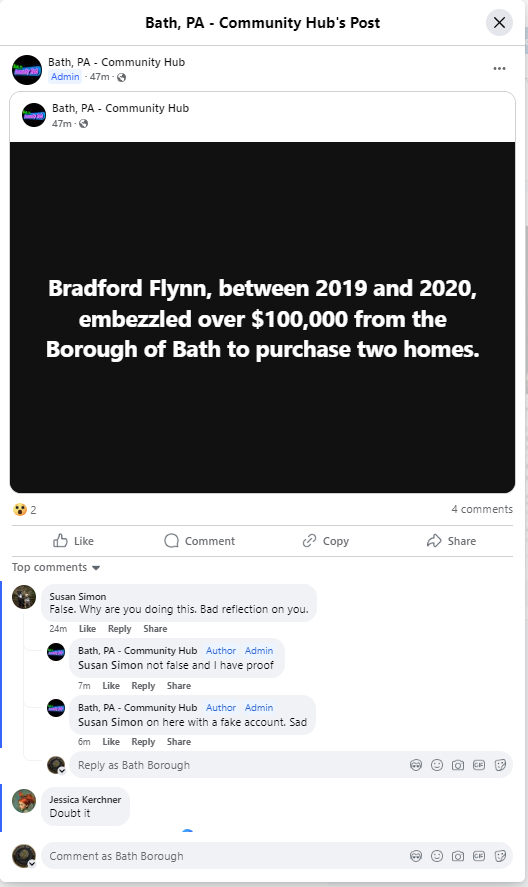
The post provides no proof of wrongdoing, therefore is a false statement to mis-disinform the Borough’s community.
Later the same day, at around 5PM, the Bath PA Community Hub posted the following 183-page report:
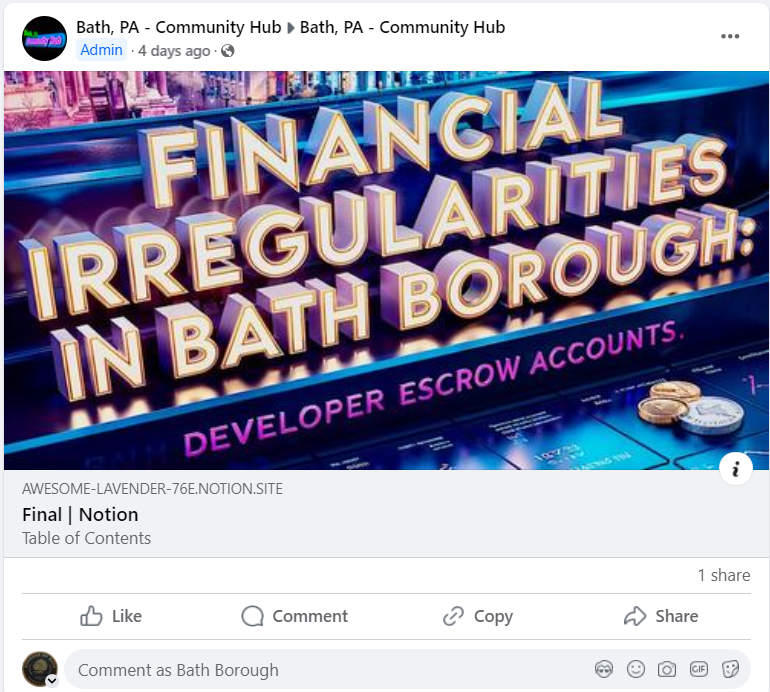
The report states, under Section 1.6 “…it’s important to note that these findings do not definitively prove intentional misconduct.” The initial post, see first image above, definitely states that Bradford Flynn, between 2019 and 2020 embezzled $100,000 from the Borough of Bath to purchase two homes. Yet, the Bath PA Community Hub’s promised report seeking to provide evidence of wrongdoing (alleging Manager Flynn committed embezzlement–serious accusations) begins its opening chapter with a conclusion statement that the findings of the report, in fact, do not definitively prove misconduct.
The report also fails to provide any evidence that Manager Flynn purchased a second home with alleged embezzled money as the opening Facebook post contends.
11 – Posts by Michael Long on July 15, 2024, to a citizen comment under Michael Long’s Bath, PA Community Hub | July 14, 2024, Community Letter.
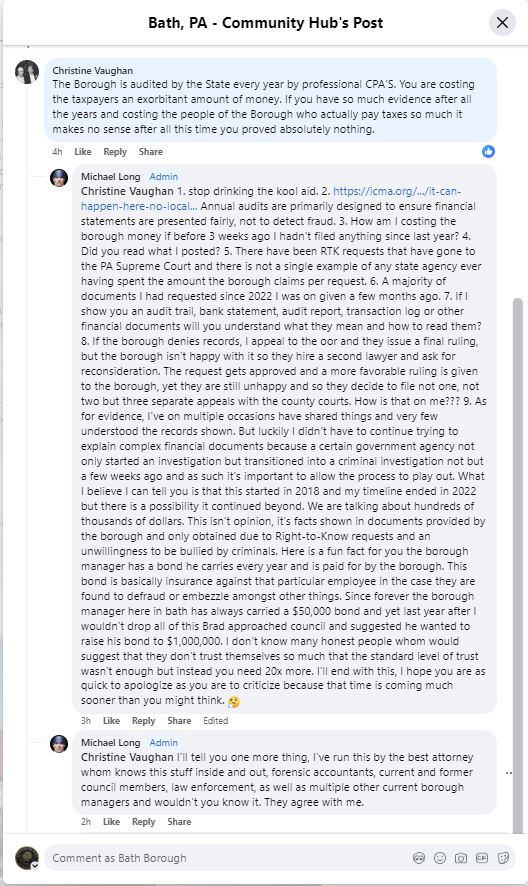
Statement: MISCHARACTERIZATIONS. FALSE AND/OR MISINFORMATION.
Subject #1 – No response warranted.
Subject #2 – Long’s characterization of a Borough Audit regarding auditors’ primary duty to ensure financial statements are presented fairly and that auditors do not detect fraud is his alone. Borough staff are probed by auditors about fraud. Bath’s auditors conduct random tests of the Borough’s accounts. Long has asserted that ‘hundreds of thousands of dollars’ have somehow disappeared, without evidence, and implies Bath’s auditors wouldn’t have noticed.
Note on Bath’s yearly audit process:
Bath’s auditor’s are responsible for reviewing the financial statements and assess the risks of material misstatement of the financial statements, whether due to fraud or error, and design and perform audit procedures responsive to those risks. One thing to keep in mind, the risk of not detecting a material misstatement resulting from fraud is higher than for one resulting from error, as fraud may involve collusion, forgery, intentional omissions, misrepresentations, or the overriding of internal controls. The auditor’s, however, have no responsibility to plan and perform the audit to obtain reasonable assurance that misstatements, whether caused by error or fraud, that are not material to the financial statements are detected. There is a perception that the auditor’s responsibility goes beyond what is required by professional standards.
Bath’s management is responsible for the design and implementation of programs and controls to prevent and detect fraud, and for informing the auditor about all known or suspected fraud affecting the government involving management, employees who have significant roles in internal controls, and any others where the fraud could have material effect on the financial statements. Management is required to inform the auditor’s of knowledge of any allegations of fraud or suspected fraud affecting the government received in communications from employees, former employees, grantors, regulators, or others. Management is also responsible for identifying and ensuring that the government complies with applicable laws, regulations, contracts, agreements, and grants for taking timely and appropriate steps to remedy fraud and noncompliance with provisions of laws, regulations, or contracts or grant agreements.
Bath does have internal controls, which include multiple check signers. Each check signer fills out a signature card. Checks written out against the Borough are cross-checked (especially at a certain value) with the Borough’s issuing bank. The Borough’s bank also reviews checks signed by a signatory for accuracy. In other words, to electronically verify that a check hasn’t been forged by an internal or external party.
General financial practices: bills (or accounts payable) are reviewed by at least three personnel. Bank deposits are made by different personnel and include the Borough Manager. Accounts receivables are reviewed by at least two personnel. Bath’s bank accounts are reconciled to within 30 days of each closing month. Personnel with access to Borough credit cards are reconciled and reviewed by two personnel. The Personnel, Finance, and Administration Committee (the officers of Borough Council) have oversight of the Borough Manager and all of the Borough’s financial data.
Subject #3 – Long asks the question, how he could be costing the Borough money if before 3 weeks ago he hadn’t filed anything since last year? Long is oversimplifying his impact from Right-to-Know Requests, ensuing appeals (appeals lasting months upon months where Long perpetuated the record– one appeal accounted for 68 docket entries and spanned just over 5 months from May 12, 2023, to September 22, 2023), and Long’s ridiculous challenges to the Borough’s County Court petitions for review. See also Right-to-Know: The Costs Behind One Requestor.
Subject #4 – No response warranted.
Subject #5 – Long asserts “[t]here have been RTK requests that have gone to the PA Supreme Court and there is not a single example of any state agency ever having spent the amount the borough claims per request.” Needs context. Long does not cite a reference to this statement.
There is a 2017 report by the Pennsylvania Legislative Budget & Finance Committee (LB&FC) regarding the Cost to Implement the Right-to-Know Law. This report disproves Long’s repeated false claim. See also Item #60 of this webpage for more information and a link to the report. Long’s statement is misleading.
Subject #6 – Long states a “majority of documents I had requested since 2022 I was [only] given a few months ago.” False. Long has made several Right-to-Know Requests from 2022 through 2024. Please see Subject #3 above. This statement is a mischaracterization of events.
Long had received documents relative to Docket #2024-0001. Long made a series of requests (outside of the Right-to-Know Law) in March, April, May, and June of 2024 where he’s been given hundreds of more documents. It’s not true that Long received documents requested since 2022.
Subject #7 – Long states if he were to [show the commenting citizen] “audit trail, bank statement, audit report, transaction log or other financial documents will you understand what they mean and how to read them?”
Based on Long’s comment’s during public meetings where the Borough has corrected Long on these very issues, the Borough is not positive Long understands or knows how to read an audit trail, bank statement, audit report, transaction log, or other financial documents, let alone be in a position to explain these things to another member of the community.
For example, during the March 11, 2024, Council meeting, Long asserted a check was missing from the Mayor’s Fund, according to a Reconciliation Report he obtained. The check wasn’t missing, and the Borough pointed out to Long how to read Bath’s Reconciliation Report.
In another example, Long asserts that changes made to a general fund, general ledger account, as found on an Audit Trail supports wrongdoing or fraud. It’s not. The Audit Trail Report is reporting on all the changes made to a general ledger account. This happens because sometimes an amount of money is booked to one general ledger line where it should be booked to a more appropriate ledger line. These changes may happen at different times over the year and after the Manager and Bookkeeper discuss the issue. There’s no wrongdoing in making these adjustments and is common practice.
It is also common practice to make ledger line changes or adjustments in a current budget year, during the audit process of a previous budget year, and in accordance with the auditing accountants. Once the Borough’s books are reviewed and solidified by the Borough Auditors and submitted to the state (unless the state requires further changes) then no other changes can be made to the Borough’s books after the closeout.
Subject #8 – Long states “If the borough denies records, I appeal to the oor and they issue a final ruling, but the borough isn’t happy with it so they hire a second lawyer and ask for reconsideration. The request gets approved and a more favorable ruling is given to the borough, yet they are still unhappy and so they decide to file not one, not two but three separate appeals with the county courts. How is that on me???” Long is grossly mischaracterizing the record on this issue to misinform readers. See Docket #2023-1598 for more information.
Long has consistently inverted issues to serve his own purposes. Long doesn’t explain how he misapplies rules, or how he’s jammed the court docket relative to OOR AP 2023-1598 with unnecessary motions that serve no purpose other than to create work for Bath’s attorneys.
Subject #9 – No response warranted. Long’s continued hyperbole.
Long’s post, relative to the Borough Manager’s insurance bonding, please see Item #62 on this webpage for more information. Long has made continuous erroneous claims about Manager Flynn’s bonding insurance.
10 – Written Communication by Michael Long posted to the Bath, PA Community Hub | July 14, 2024.
Entire Statement. PARTIALLY TRUE. LARGELY MISCHARACTERIZED. FALSE. MISINFORMATION.
Subject #1 – Long mischaracterizes the complexity of his Right-to-Know Requests. Long consistently submitted Requests that lacked specificity or were overly broad or required several years of documentation.
Long fails to provide clarity because he represents to the public by minimizing the number of Requests or its content, and then casually leaves out all the details of the extensive Request appeals, he’s filed, which have been labor intensive.
Long’s appeals are listed on the Borough’s website, under the ‘Government’ menu, then select the ‘Right-to-Know’ webpage which has a sub-page dedicated to all Right-to-Know appeals relative to Bath. Through June 30, 2024, Long accounts for 75% of the Borough’s Right-to-Know appeal caseload since the Right-to-Know Law was amended in 2008.
Subject #2 – The OOR has not consistently rejected the Borough’s claim that Long’s requests are disruptive or made in bad faith. In part, it’s the other way around. Long has consistently demanded the OOR find the Borough has acted in bad faith during the RTK Request process. OOR has declined to make a finding of bad faith, because there is no evidence to support a position Bath has acted in bad faith.
Additionally, the Borough asked the OOR to find one item of several items Requested to be disruptive relative to Docket #2023-1083 (continual request for the mayor’s health insurance reimbursements and an audit trail report that couldn’t be produced the way Long desired), where OOR thought the Borough meant the entire Request. The Borough was not asking OOR to deem the entire Request disruptive. OOR erred and didn’t understand the Borough’s position and made a finding the overall Request was not disruptive.
See Borough’s response under Docket #2023-1083 (page 2 of the OOR Final Determination): Item #12.2023 – the Request is disruptive because the records were previously provided, as evidence by Long v. Bath Borough, AP 2022-2675, and the Request was filed to burden the Borough staff. The Borough also argues that the “audit trail” does not exist and cannot be created, as explained in AP 2022-2675.
Subject #3 – Long cites the Borough’s costs associated with his Requests are ‘a gross exaggeration.’ Long submits no evidence of his claims. Bath’s evidence of Long’s Right-to-Know costs can be found in this article: Right-to-Know: Costs Behind One Requestor
The information may also be obtained from the Borough’s publicly available monthly Treasurer’s reports from 2023 and 2024, under the Borough’s website; ‘Departments’ menu, then under ‘Financial Administration.’
Subject #4 – Long cites “[a] particularly egregious example of the borough’s lack of transparency involving QuickBooks audit trail.” Long has appeared on local news admitting he has zero accounting or finance training as he claims to understand audit trail reports. Long further alleges the Borough withheld an audit trail report requested on or about May 5, 2023, but later obtained this mysterious report having to “outsmart” the borough during a mediation process of another appeal. False.
Long never provided the Borough with a ‘document’ the Borough could identify, retrieve, and forward to him during the May 5, 2023, response timeframe.
Long asked for an audit trail report for the mayor’s insurance reimbursements. It was phrased in a way where the Borough didn’t understand what was being requested. It is not the Borough’s position to guess or make judgements as to the records a Requestor is looking for. The Borough is not required under the Right-to-Know law to create records it doesn’t already maintain.
Bath’s QuickBooks was not able to generate the report Long thought was available, and this was explained to him. It wasn’t until the mediation case where, after much confusion between Long himself (not understanding Bath’s accounting software), the Borough, and OOR that we each agreed to settle on running audit reports for specific general ledger account numbers and sub accounts Long desired to review. It was then, at that point, an audit trail report could be generated. For more information, please see Docket #2024-001.
Long has repeatedly asked for Audit Trail Reports that cannot be generated the way he feels it can be generated. For example, under Docket #2023-1083 Long requested an audit trail associated with excess revenue generated from the amount of funds generated versus expenses related to sanitation between 2017-2019. Long failed to identify a specific record or transaction of the Borough regarding the Sanitation Fund. Further, the Borough is not able to create an audit trail report (as Requestor demanded) because the Borough’s accounting software does not have a function that provides an audit trail report generated from a net income as may be listed on a Profit and Loss Report. The Borough has argued this point repeatedly with the Requestor.
Subject #5 – Long asserts his Requests have “brought to light numerous financial irregularities [although doesn’t specify], including bounced checks, mishandling of state funds [although provides no proof], discrepancies in financial reports, questionable healthcare arrangements [without proof], missing insurance payments by the mayor [this is true], and significant fluctuations in fund balances.” While there is some truth to this statement, most of it is mischaracterized, unclear, or false.
Bounced Checks – Yes, this does happen from time-to-time. Public payees write checks to the Borough without sufficient funds. The Borough attempts collection of these debts as does any municipality. It’s unclear what Long is trying to represent.
Discrepancies in Financial Reports – Long doesn’t specify, but yes, there were times, prior to the Borough’s current Treasurer Report format, previous versions of the report were partially submitted to Council, or incomplete because of missing information (delayed account reconciliations). There were undeniable instances of sloppy bookkeeping work. This has been explained to Long a number of times and in a number of different ways without divulging conversations between management and an employee(s). There are no instances of misappropriation of funds or any level of criminality, despite Long’s repeated claims there is, while providing no evidence.
To be clear, ‘misappropriate funds’ means a person, with intent, through dishonesty, or unfairly takes something, especially money belonging to another for one’s own use. Embezzlement.
Mayors Missing Insurance Payments – Long’s first Request sped up the process for the Borough to review the insurance reimbursement issue. Long helped the Borough identify the issue, even though the Borough would have discovered the issue through the 2022 end of year reconciliation under the new bookkeeper.
Fluctuations in Fund Balances – In government, revenues and expenses do fluctuate from year to year. Long fails to point out any real concern with how this fluctuation of fund balances presents a problem. It is unclear what Long is trying to represent.
Manager Flynn’s Insurance Bond – Manager Flynn discussed his insurance bond with his providers (which had always been set to a limit of $100,000, not $50,000 as alleged by Long) given the amount of money accessible to the Borough Manager. The insurance carrier recommended a bonding limit to $1,000,000. Historically, Bath managers had been significantly underinsured. Manager Flynn corrected the issue. Long’s statements regarding this issue are misinformation and false.
Subject #6 – Long asserts the Borough is deflecting blame onto a resident for their own fiscal mismanagement. Bath is simply pointing out facts. If Long doesn’t like being called out for his conduct, he has the power to end it by stop mis and dis-informing Bath’s public, engaging the Borough in vexatious Requests and where unnecessary, submitting court filings that serve no purpose. Just because Long disputes or disagrees with a fact, it doesn’t make the fact less true.
Long fails to realize, he is the one driving this bus. Long fails to use reason, prudence, care, foresight, or intelligence to know his conduct, the conclusion or expectation in this circumstance is placing others at risk of financial harm. The resources and tax money spent to try and understand Long’s requests, providing Long with thousands of pages of documents, and even attempting to work with Long outside of the Right-to-Know Law have been exhausting and it can’t be sustained.
Another example of Long’s unreasonableness was on display in the WFMZ 69 News piece linked above. Long was asked on-camera if it bothered him the Borough has spent nearly $150,000 on him alone. Long’s reply, ‘no.’
Because Long is unreasonable, and since Long raises ethical lapses and abuse of power, yet casually sidesteps his abuse of process, here are some examples of Long’s improper conduct related to County Court of Common Pleas Docket #CV-2023-10559 (there are more reported cases outside this list of examples, both in court and during Long’s Right-to-Know state appeals):
- On June 10, 2024 Long files a motion in court to dismiss the Borough’s petition.
- Paragraph 13, Long submits to the court: The Pennsylvania Commonwealth Court has held that the filing of a petition for reconsideration renders the underlying order non-final for purposes of appeal. See Sossong v. Shinseki, 63 A.3d 858, 862 (Pa. Commw. Ct. 2013). Citation Sossong v. Shinseki, 63 A.3d 858, 862 (Pa. Commw. Ct. 2013) DOES NOT EXIST.
- Paragraphs 17, 22, and 41 Long submits to the court: At 17 – In City of Philadelphia v. Frempong, 865 A.2d 314, 316 (Pa. Commw. Ct. 2005), the Commonwealth Court emphasized the importance of strict compliance with service requirements, stating that failure to adhere to these requirements can invalidate service and deprive the court of jurisdiction. This case underscores the necessity of serving legal documents by certified mail to establish proper service. At 22 – The Borough may argue that it substantially complied with the service requirements. However, Pennsylvania courts have consistently held that strict compliance with service rules is necessary to establish jurisdiction. In City of Philadelphia v. Frempong, 865 A.2d 314, 316 (Pa. Commw. Ct. 2005), the court emphasized that failure to adhere to service requirements can invalidate service and deprive the court of jurisdiction. At 41 – The Borough may argue that it substantially complied with the requirements for filing a praecipe of readiness. However, Pennsylvania courts have consistently held that strict compliance with procedural rules is necessary to establish jurisdiction and proceed to trial. In City of Philadelphia v. Frempong, 865 A.2d 314, 316 (Pa. Commw. Ct. 2005), the Commonwealth Court emphasized that failure to adhere to procedural requirements can invalidate filings and deprive the court of jurisdiction. LONG REFERENCES CITY OF PHILADELPHIA V. FREMPONG, 865 A.2D 314 (PA. COMMW. 2005) FOR THE PROPOSITION THAT “THE COMMONEWEALTH COURT EMPHASIZED THE IMPORTANCE WITH SERVICE REQUIREMENTS” AND THAT THIS “CASE UNDERSCORES THE NECESSITY OF SERVING LEGAL DOCUMENTS BY CERTIFIED MAIL TO ESTABLISH PROPER SERVICE.” THIS CASE DOES NOT DISCUSS SERVICE AT ALL, LET ALONE BY CERTIFIED MAIL.
- Paragraph 18, Long submits to the court: The Pennsylvania Superior Court has held that service by regular mail alone is insufficient to satisfy the rules of civil procedure. See Wilco Elec. v. Weco, Inc., 586 A.2d 956, 958 (Pa. Super. Ct. 1991) Citation Wilco Elec. v. Weco, Inc., 586 A.2d 956, 958 (Pa. Super Ct. 1991) DOES NOT EXIST.
- Paragraph 20, Long submits to the court: In Green Acres Rehab. & Nursing Ctr. v. Sullivan, 536 A.2d 515, 518 (Pa.Commw. Ct. 1988), the Commonwealth Court held that proper service is a jurisdictional requirement, directly supporting the argument that improper service can result in a lack of jurisdiction. Citation Green Acres Rehab. & Nursing Ctr. Sullivan, 536 A.2d 515, 518 (Pa. Commw. Ct. 1988) DOES NOT EXIST.
Long has submitted blatant misrepresentations to County Court to fit his own purpose. For more information, please see Docket #2023-1598.
Long’s unnecessary court motions have a taxing effect on the Borough’s legal team and presents an existential economic threat to the Borough’s taxpayers.
Subject #7 – Long alleges the Borough’s dissemination of false information not only jeopardizes Long’s reputation but also potentially endangers Long’s family’s safety. The Borough isn’t lying about any of the information it has disseminated to the public. If Long doesn’t like being called out for his conduct, he should stop misinforming the public with Bath’s records, and he can stop engaging the Borough through vexatious Requests and court filings, where such court filings are completely unnecessary.
Subject #8 – Long wants a retraction of all false statements about his RTK Requests, although Long provides no evidence of the Borough’s false statements. Long issues other demands Bath isn’t entertaining. Long demands a forensic audit. Bath is independently audited in accordance with state law, each year. Bath’s Financial Audits are provided on the Borough’s website.
Long is not interested in a reasoned debate. Any information contrary to Long’s beliefs or narrative, he wants strictly removed from public view. The remedy for speech that is false is speech that is true.
Subject #9 – Long challenges Borough Council members to a number of demands. Long has challenged Council, staff, professional services, and its taxpayers enough.
Borough Council is being advised on every one of Long’s Requests, appeals, and Bath’s court petitions by Manager Flynn, the Borough Solicitor and Borough Special Solicitor for Right-to-Know matters.
9 – Statement: “Transparency comes at no cost, yet the borough’s secrecy has incurred a staggering $150,000 bill, paid with taxpayer money.” Bath, PA Community Hub post (or repost) by Michael Long referencing a recent news story about how his right-to-know requests are costing the Borough of Bath.
Statement: PATENTLY FALSE.
In Michael Long’s overall public post where the above statement excerpt was obtained, he appears to cite information from the Pennsylvania Legislative Budget & Finance Committee (LB&FC) report issued on February 27, 2018, entitled Cost of Implementing the Right-to-Know Law. This issue is more complex than Long leads readers to believe.
First, Long’s statement is flawed and contradicts Long’s overall post (see Item 60 of this webpage) where Long cites actual costs of Right-to-Know Requests in a report issued by the state LB&FC but then informs the public there are no costs to transparency. Long then sets out his conspiracy theories of government secrecy. (See Long’s full Facebook post under Item 57 of this webpage.)
The LB&FC report Long appears to cite from has a section devoted to Right-to-Know costs and makes this point clear: “Most of Pennsylvania’s state and local government agencies incurred costs responding to Right-to-Know Law (RTKL) requests.” (Page 30.)
The report looked into the costs incurred to implement the Right-to-Know-Law of 640 state and local government agencies out of a total survey sample size of 1,093. Keep in mind, there are more than 6,000 state and local government agencies across Pennsylvania. Many other state agencies were not part of this report. LB&FC sampled a small representation of the whole.
LB&FC, using two different calculations, one focusing on the general cost of implementing the Right-to-Know Law and another that examined estimating cost of wages for time spent processing Requests for all state agencies.
LB&FC found that in Calendar Year 2016 (in just one year) the annual cost to implement the Right-to-Know Law among the 640 agencies ranges between $450 and $406,000. When only considering Boroughs surveyed, the high-end cost was $32,000 and the median was $200.
In 2016, the annual Right-to-Know processing cost per individual agency:
- 54% reporting annual costs of processing Requests of $500 or less;
- 19% reporting annual costs ranging from $501 to $2,000;
- 19% reporting annual costs ranging from $2,001 to $10,000;
- 8% reporting annual costs ranging from $10,001 to over $400,000
LB&FC then reviewed the middle 50% of surveyed respondents, finding that the average cost per Request was around $61. The number of Requests process in 2016 was determined to be 109,140. The annual estimated cost was around $6.6 million.
Using the findings of cost per Request among the surveyed agencies, LB&FC found that in Calendar Year 2016, the estimated cost responding to Right-to-Know Requests by all state agencies was between $5.7 million to $9.7 million. When only considering Boroughs, the lower end was $816,400 with an upper end of around $1,394,028.
These findings completely disprove Long’s statement that ‘[t]ransparency comes at no cost…’
The rest of Long’s post concerning spending $150,000 of taxpayer money to withhold a Borough secret(s) is baseless and false.
From October 2022, through June 2024, Bath has spent a combined $144,598.32 dealing with Long’s multiple right-to-know requests in multiple sub-parts, Long’s appeals, the Borough’s court filings, and among other reasons over a 21-month period. The costs include time billed for legal (largest portion) but also costs associated with bookkeeping review, IT, and auditors who have all performed work on Long’s requests. For more information, please read this article: Right-to-Know: The Cost Behind One Requestor.
8 – Statement: “A 2016 study on RTK law expenses highlighted that the most costly case was $12,500, a sum our Borough [Bath] has now far exceeded without actual court proceedings.” Bath, PA Community Hub post (or repost) by Michael Long February 21, 2024, then edited and/or reposted July 2024 referencing a recent news story about how his right-to-know requests are costing the Borough of Bath.
Statement: NEEDS CONTEXT. CHERRY-PICKING. FALSE COMPARISON. OVERSTATED. MISLEADING CONTENT.
While offering no source citation, Long appears to reference a report issued by the Pennsylvania Legislative Budget & Finance Committee (LB&FC) issued February 27, 2018, regarding the costs of implementing the Right-to-Know Law. This is issue is more complex than Long leads readers to believe.
In LB&FC’s report, of 1,093 total state and local agencies surveyed, only 640 reported annual cost on a per Right-to-Know Request basis. There are over 6,000 state agencies. There are many state agencies that were not part of this report. The report notes that most agencies are not tracking right-to-know expenditures and the sample size is small. Also, because of the significant number of outliers in the states report, LB&FC averaged the middle 50% of reported costs.
From this, LB&FC concluded that during calendar year 2016 of the 640 agency respondents cost per Request:
- 52% of surveyed agencies reported costs of $50 or less per request.
- .08% reported costs between $200 or more per request.
- .04% reported costs between $1,000 and $12,500 per request.
LB&FC further stated, “More than half of the agencies surveyed reported costs of $50 or less per request. However, about 1% of the 48 agencies reported costs of $200 or more per request, including half of those agencies (23) reporting costs that range from $1,000 to $12,500 per request.
LB&FC does note, they examined only the middle 50% of surveyed respondents, as there were agencies reporting very high costs per Right-to-Know Request that would skew the sample size (see page 33 of the report). This means there were agencies reporting cost per request over $12,500. Manager Flynn confirmed this by discussing the report findings with the Executive Director of the LB&FC.
Long saying the costliest right-to-know case was $12,500 is false.
Also, LB&FC report doesn’t inform readers about the complexity or content of the Requests. Although there is a section of the report dedicated to man hours spent processing a request. LB&FC breaks down Requests under defined terms of; General, Commercial, Discovery/Litigation, Inmate, Media, Research (schools/universities), and Out-of-State.
Also, Long did not make just one Request. Long doesn’t share with readers the true extent of his Requests, or how these Requests have been written in multiple sub-parts. Long’s Requests have been complex, covered several years of records, required legal review, and Long has filed multiple appeals requiring additional legal assistance. Long shares misleading content.
Overall, Long is generally overstating and cherry-picking data without providing readers context of the complex nature of his Requests. Long’s statement is also falsely comparing his Requests for the Request’s outlined in the LB&FC report, which gives no details of Request content other than aggregate data.
For more information about Long’s Requests, see this article.
7 – Statement: “The borough’s legal spending in response to this single request has surged to between $100,000 and $150,000…”Bath, PA Community Hub post (or repost) by Michael Long February 21, 2024, then edited and/or reposted July 2024 referencing a recent news story about how his right-to-know requests are costing the Borough of Bath.
Statement: PATENTLY FALSE.
The Borough’s legal spending is NOT in response to a single request asserted by Long, to have surged to between $100,000 and $150,000. This is absolutely false information.
From October 2022, through June 2024, Bath has spent a combined $144,598.32 dealing with Long’s multiple Right-to-Know Requests in multiple sub-parts, Long’s appeals, the Borough’s court filings, and among other reasons over a 21-month period. The costs include time billed for legal (largest portion) but also costs associated with bookkeeping review, IT, and auditors who have all performed work on Long’s Requests.
For more information, please read this article: Right-to-Know: The Cost Behind One Requestor.
From September 2022 to June 30, 2024, the Borough has processed 14 Right-to-Know Requests from Long. Taking Bath’s total costs (to include non-RTK Requests) relative to Long, through June 30, 2024, and dividing that by 14 Requests results in roughly $10,328.45 per Request. Long’s cost per request is slightly lower than estimate provided, when removing time spent on his non-RTK document requests.
6 – Statement: “The borough, dissatisfied with the Pennsylvania Office of Open Records decision, sought and received reconsideration, only to file two statutory appeals with the Northampton County Civil Court. After another ruling, they initiated a third appeal and three motions to dismiss my responses to these appeals.” Bath, PA Community Hub post (or repost) by Michael Long February 21, 2024, then edited and/or reposted July 2024 referencing a recent news story about how his right-to-know requests are costing the Borough of Bath.
Statement: PARTIALLY TRUE. PARTIALLY MISCHARACTERIZED AND/OR FALSE.
While, true, the Borough has taken three petitions for review up with the Northampton County Court of Common Pleas regarding an appeal initiated from Michael Long with the Office of Open Records, the rest of Long’s post is either misleading or false.
The Borough asked the Office of Open Records for reconsideration, stating 3 inseparable reasons. The Office of Open Records granted reconsideration for only 2 of the 3 reasons, effectively denying reconsideration and setting the stage for Bath’s appeal. See under Docket No. 2023-1598 for more information.
The Borough has not filed motions to dismiss Long’s responses to the Borough’s petitions. Long can issue responses. The problem Bath has faced is Long is filing unnecessary motions filled with false legal reasoning and case citations that either don’t exist or don’t stand for the legal proposition stated. This forces the Borough to file motions in response.
5 – Statement: “Usually, a borough fulfills 89% of RTK requests within five days, occasionally using a 30-day extension in 11% of cases. In stark contrast, my RTK request from May 17, 2023, is an outlier, remaining active nine months on.” Bath, PA Community Hub post (or repost) by Michael Long February 21, 2024, then edited and/or reposted July 2024, referencing a recent news story about how his right-to-know requests are costing the Borough of Bath.
Statement: NEEDS CONTEXT. MISLEADING.
Long cites data about Pennsylvania borough’s fulfilling 89% of RTK requests within five days, occasionally using a 30-day extension in 11% of cases. Long does not provide a resource citation or where the information was obtained.
The Borough was able to obtain a copy of a report from the Pennsylvania Legislative Budget & Finance Committee (LB&FC) entitled Costs to Implement the Right-to-Know Law, presented to Pennsylvania legislators on February 27, 2018. The study was directed under House Resolution 50 of 2017 to review right-to-know matters during calendar year 2016.
At face value, Long’s statement leads a reader to believe that across Pennsylvania, of all Borough’s, 89% process right-to-know requests in 5 days, only 11% of Borough’s needing 30-day extensions. This is false because the report does not incorporate all Pennsylvania Boroughs.
The LB&FC report only surveyed 1,093 state and local agencies. Meaning, LB&FC surveyed Commonwealth offices, colleges, legislative agencies, the judiciary, City of Philadelphia, other cities, counties, school districts, townships, and Boroughs. For context, there are some 956 Borough’s in Pennsylvania. The report has data on possibly 145 Boroughs. The LB&FC report accounts for a fraction of the overall Borough’s across the state. The numbers cited by Long are only for a portion of the Borough’s surveyed.
For Long to represent that Pennsylvania Borough’s processed 89% of the right-to-know requests in 5 days, with only 11% of Borough’s needing the 30-day extension is false and misleading readers without further context.
See Michael Long’s updated post to the Bath, PA Community Hub:
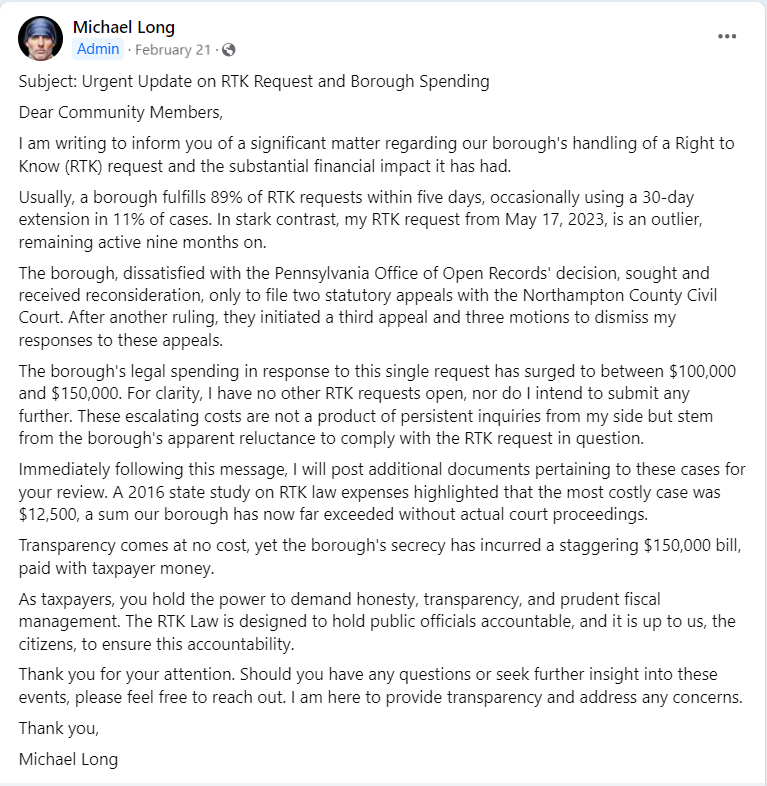
4 – Statement: “I looked up the court filings mentioned. Why are they [the Borough] blaming you for that when they initiated THREE cases against you? Bath, PA Community Hub post on or about July 12, 2024, by writer Sheryl Reese referencing the 69 News story ‘Resident’s multiple Right-to-Know requests could end up costing Bath taxpayers, borough manager says.
Statement: PARTIALLY TRUE. PARTIALLY MISLEADING.
The Borough isn’t completely ‘blaming’ Michael Long, nor has the Borough ‘initiated THREE cases against [Long]”.
The Borough has initiated three petitions for review (statutory review; not civil lawsuits) with the Northampton County Court of Common Pleas, disagreeing with the Pennsylvania Office of Open Records determinations and the application of rules in one of Long’s appeals.
While Michael Long can file a ‘response’ to the Borough’s petitions, he has taken matters further by filing court ‘motions.’ Something completely different. Filing motions triggers the Borough to investigate and respond accordingly. It’s taxing on the Borough, especially when the motions Long has filed are compiled with incorrect legal data. It then forces the Borough into a motions hearing.
Michael Long’s numerous motions are full of case citations and legal propositions that are unsupported by cases referenced, or the cases cited don’t even exist. Michael Long was warned about this conduct before and has persistently ignored the Borough’s warnings. For Long’s part, the Borough will seek to hold him accountable, and does blame him for protracting this matter, and clogging this court docket with unnecessary filings.
3 – Statement: “Sh*t like this is why I questioned what was going on back when the mayor blew you [Michael Long] up on Facebook to start…” Reese Post in General Bath, PA Community Hub post on or about July 12, 2024, by writer Sheryl Reese referencing the 69 News story ‘Resident’s multiple Right-to-Know requests could end up costing Bath taxpayers, borough manager says.
Statement: PARTIALLY TRUE. NEEDS CONTEXT. OVERALL POST IS MISLEADING.
While true, Ms. Reese ‘questioned what was going on’ in 2022, she did so, while completely her right, by filing multiple Right-to-Know Requests to Bath from 2022 through 2023 and around the same time Long was filing his Requests.
Reese could have held conversations with Borough Officials for more information as an affiliate through her acquaintance, former Bath Borough Council President, Mark Saginario. The information herein also corroborates Long’s comments about speaking to past and present Borough officials.
In Reese’s post, she makes representations to the public in one way, but thinks about the circumstance in another. The information that follows explains the Reese/Long dynamic so the public can better understand the information they are consuming from either Long or Reese herself. This information is also useful because it contains sediment by someone other than a Borough Official stating Long has been inaccurate in many of his claims.
This post, taken as a whole, is akin of cognitive dissonance; the state of having thoughts, actions, beliefs or desires that are inconsistent with one another. To illustrate this point: Someone who smokes, who knows smoking can kill or cause cancer, but says they want to live a long healthy life. Their belief(s) are at odds with their actions.
This post by Reese is at odds with what she knows about Long and expressed to Manager Flynn in an email (included below) dated July 20, 2023, one year earlier.
See Ms. Reese’s post to the Bath, PA Community Hub (on or about July 12, 2024):
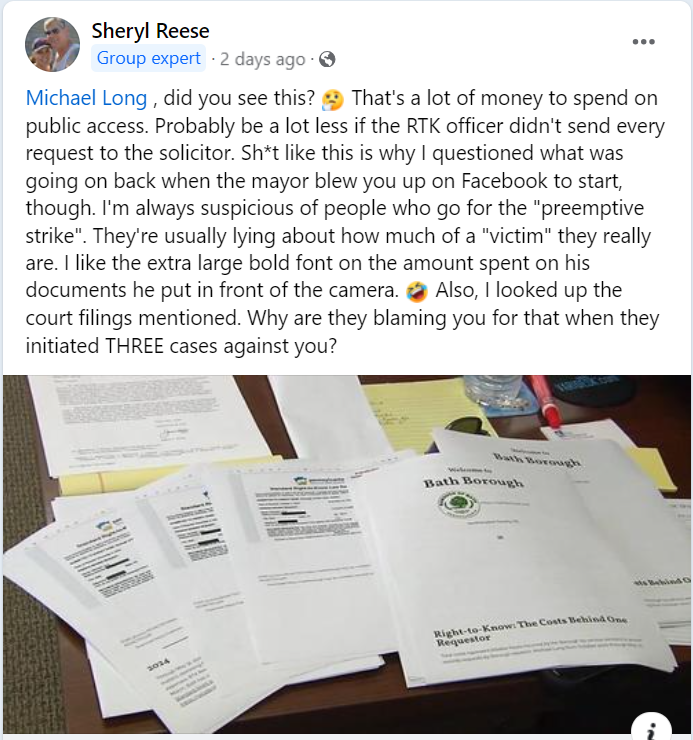
To begin, Ms. Reese accounts for the most Right-to-Know Requests Bath received in 2022 and 2023. The Borough suspected Reese and Long may, to some extent, operated in tandem. It’s also possible their combined requests are purely coincidental. Reese and Long did ask for a lot of the same information.
In 2022, Ms. Reese filed 9 of the Borough’s 22 Right-to-Know Requests, accounting for 41% of the Borough’s caseload. Most of any Requestor that year. Long second most requestor, accounted for 9% of the Borough’s requests. On November 18, 2022, Reese filed 8 Right-to-Know Requests. Also, coincidently on the same day Michael Long filed his second Right-to-Know Request of that year.
In 2023, Ms. Reese would go on to file 14 more Right-to-Know Requests, accounting for 37% of the Borough’s caseload. Again, most of any Requestor that year. Long was the second most Requestor with 26% of the caseload. In one day, January 17, 2023, Ms. Reese filed 10 requests. Some of Reese’s requests repeated requests for information from Long. For example, both Reese and Long have asked for documentation relative to the mayor’s health insurance premium repayment. Reese requested the Borough Manager’s bonding insurance. Long has publicly discussed at length matters about the Manager’s expanded coverage limits of his bond amounting to wrongdoing. Which is false.
In 2023, legal expenses alone associated with Ms. Reese’s requests were estimated at $9,365.35. Later in 2023, Ms. Reese’s requests were relative to other matters seemingly detached from Long. To see Ms. Reese’s requests, check the 2022 and 2023 Bath Right-to-Know Tracking Logs. Long and Reese account for the most amount of money spent on Right-to-Know Requests, likely in Bath’s history.
On July 20, 2023, Ms. Reese sends Manager Flynn an email. In the email, Ms. Reese wanted to discuss, among other things, the cost of Right-to-Know Requests, saying “I know what I have asked for, and with the exception of a couple requests, I can’t imagine that basic financial documents would require much legal review.”
While Ms. Reese’s email minimizes/mischaracterizes the impact of her requests, she at least acknowledged, some of her requests come at a cost to the Borough. Reviewing Reese’s July 12, 2024, post and her email of July 20, 2023, it reveals Reese is somewhat conflicted. On one hand, Reese is saying in her July 12, 2024, post, Right-to-Know costs Bath is facing is comical. When, on the other hand, she absolutely knows there is cost with her own requests, let alone Long’s requests. Although Reese is quick to point out in her email, she has no idea what Long has filed in requests.
More importantly, Ms. Reese’s July 20, 2023, email goes on to explain (referencing ‘Mark’ as in former Bath Borough Council President, Mark Saginario) according to what she observed, Mark, trying to “clear up some of [Long’s] misconceptions about several items” in interactions with Long. Ms. Reese goes on to list a couple examples of Long’s misbeliefs. Including Long’s misconception about the Manager’s bonding insurance.
For almost two years now, Michael Long has parroted misappropriation of funds, fraud, embezzlement, nepotism, among other things about Borough officials and all without evidence. While Manager Flynn admits some of Bath’s inner-office practices were not perfect, there was in no way crimes committed. Long is widely using Borough data and information with his own bias to continually mis and disinform the public.
Ms. Reese’s July 20, 2023, email is a call out to Manager Flynn. Reese’s email explains an attempt to truly assist Michael Long understand Borough financials, among other things (even with a former Borough official) and apparently to no avail. Long is still espousing the wrong information about the Manager’s insurance bond today. For more context: Manager Flynn’s, and those managers before him held a bonding insurance limit of $100,000 not $50,000 as Long claims. Flynn’s insurance was increased to $1,000,000 because Flynn was significantly underinsured given the amount of public funds, he has access to, and after Flynn discussed the matter with the insurance company. And a year ago, for Reese to go as far as to inform Manager Flynn of this one issue of many where Long was provided explanation, that Long refuses, is telling.
Ms. Reese’s July 12, 2024, public comment needs this context. Reese writes in support of the narrative that the Borough is falsely victimized by Long’s requests. But Reese’s comments do not support what she knows. Reese knows Mark tried to correct ‘several’ of Long’s wrong and inaccurate ideas almost a year ago. Unless she truly doesn’t believe Mark. Long consistently extracts this information from the Borough, putting his own spin on reality, which isn’t true to the facts.
Manager Flynn’s bonding insurance is particularly noteworthy. Ms. Reese’s has the insurance bonding information from her requests of 2022 to January 17, 2023. Reese learned and recognized Long is to some degree misguided. This is evident based on Reese’s email (coming seven months after she received Manager Flynn’s bonding insurance information and without contradiction). Reese also said she witnessed Mark– who is Tatamy’s Borough Manager, and similarly bonded the same as Manager Flynn– another authority figure educating Long about bonding insurance coverage limits. Reese’s email is instructive from Long’s perspective, someone who could care less about explanations. Further demonstrating, Long uses the Right-to-Know process for ill will (look up any of the other notable statements on this website from 2022 through 2024 that concern Michael Long or his Facebook group Bath Pa, Community Hub).
Reese could be more responsible, lowering the temperature of the situation, being true to herself, and standing up for the truth. Michael Long has been wrong on numerous issues. Reese knows this. Otherwise, why even email Manager Flynn on July 20, 2023, about her concerns and sharing Long’s wrong ideas through the information he’s obtained from the Borough?
It’s one thing to use the Right-to-Know law for looking under the hood of government. To see its operation and all of its potential flaws. Highlighting mistakes or scrutinizing governmental policy; these are certainly within the public’s right to openly opine or criticize, harshly even. Especially if you have a command of the facts. Reese could’ve stuck to this ideal and left the idea of Long out of it.
It’s foreseeable that Long’s Right-to-Know conduct both then and now is harmful to Bath’s taxpayers. Long largely parades around with Borough information in a false light for his own benefit. Reese knows that and fires off a public post anyway. Reese’s cognitive dissonance plays both sides of this issue, which are inconsistent. Consumers of this information should beware. Reese is conveying one thing in her post, furthering a false narrative about Bath, but believing something entirely different in her email about Long directed to Bath.
Compare Ms. Reese’s July 12, 2024, public comments with her July 20, 2023, email to Manager Flynn below:
2 – Statement: “That’s a lot of money to spend on public access. Probably be a lot less if the RTK officer didn’t send every request to the solicitor.” Bath, PA Community Hub post on or about July 12, 2024, by writer Sheryl Reese referencing the 69 News story ‘Resident’s multiple Right-to-Know requests could end up costing Bath taxpayers, borough manager says.’
Statement: MISLEADING.
Ms. Reese is referring to the Borough’s Agency Open Records Officer or AORO, sending Right-to-Know Requests to the Borough’s attorney for review and processing.
One of the Borough’s AORO is Manager Brad Flynn. The Borough’s attorney and Special Solicitor for Right-to-Know matters may also serve as Bath’s AORO, especially in situations where Manager Flynn is unavailable.
Manager Flynn does not send ‘every request’ to the Borough’s attorney. There are cases Flynn processes requests with staff and without any attorney involvement. In fact, there are cases where Flynn fulfills inquiries without the use of a Right-to-Know request at all. Use of professional services to fulfil a request, aside from legal, still comes at a cost.
Where, for example, a Request may be overly broad, lack specify, or triggers public access exemptions or a privilege, Manager Flynn will ask the Borough’s attorney to review the request and Flynn’s response to ensure exemptions and/or redactions, where necessary, are applied correctly. This is because the Borough is obligated to state denial reasons, fully backed with legal reasoning and case and/or regulation citations. Especially where such responses could lead to an appeal.
In cases where a request is appealed to the Office of Open Records, these are quasi-judicial proceedings. The Borough is guided by the Borough’s Solicitor and Special Right-to-Know Solicitor, as may be the case.
1 – Statement: “‘I have reached out many times by email to borough staff and council,’ Long said. ‘Nobody responded. I was ignored over and over. It left me with no recourse than to do this’ in filing right-to-know requests.” Morning Call article published January 19, 2024: ‘This is a vendetta’: A Lehigh Valley resident, his community are battling over his requests for open records.
Statement: MISINFORMATION.
The referenced Morning Call article opens with Bath Borough resident, Michael Long began questioning a Borough tax increase after the Borough was saving approximately $400,000 annually in police protection, about one-fourth of its budget. When Mr. Long went looking for financial data on the borough’s website, he found nothing.
Mr. Long began asking Manager Flynn financial and general borough operational questions as of January 3, 2022. Manager Flynn did respond to Mr. Long’s comments and emailed questions. Mr. Long would then file his first in a series of RTKRs later that year, September 2022 through 2023.
If Mr. Long asked any questions or emailed questions about issues pertaining to any of his pending right-to-know requests or pending right-to-know appeals, the Borough was not commenting on these open legal matters between the parties.
See original email exchange between Mr. Long and Manager Flynn below:
