
In August 2026, Borough officials received promotional materials from Michael Long, the requester in eight Right-to-Know appeals involving the Borough since 2022, for two software products.
This page presents the new materials primarily through the documents themselves. The Borough believes the distinction between what the documents establish, what Mr. Long has represented, and what remains unanswered is important.
August 5, 2026: RTK Corpus Is Introduced to Borough Officials
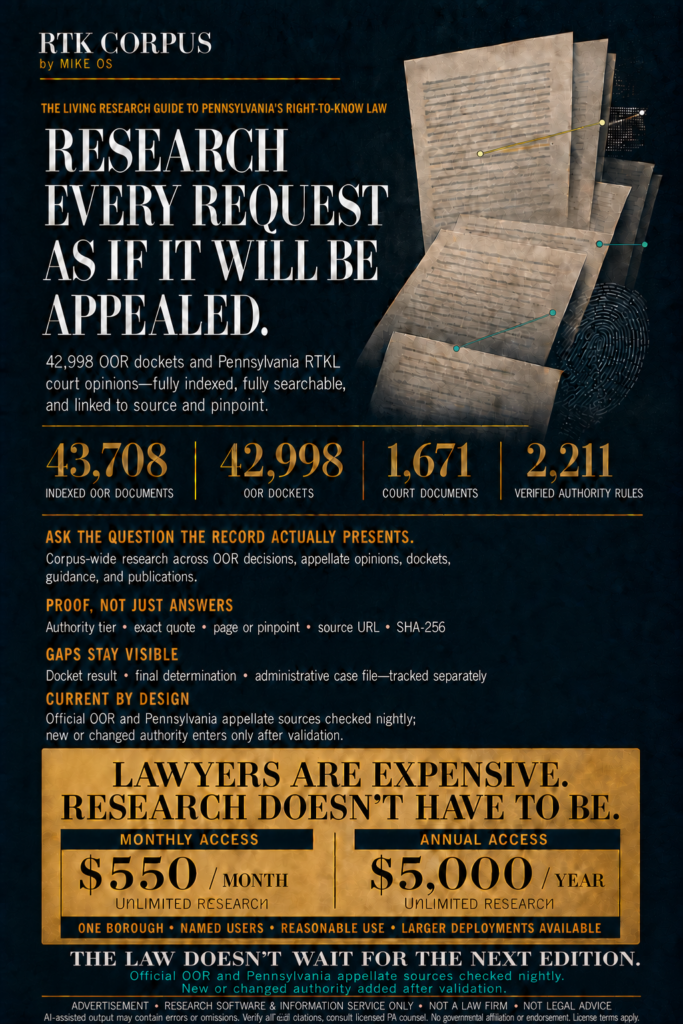
On August 5, 2026, Mr. Long sent an email to Borough Manager Bradford Flynn and the Borough’s Right-to-Know counsel, Attorney Chad Schnee, introducing promotional material for “RTK CORPUS by MIKE OS.”
The material describes RTK Corpus as:
“The Living Research Guide to Pennsylvania’s Right-to-Know Law”
and promotes the service with the statement:
“Research Every Request As If It Will Be Appealed.”
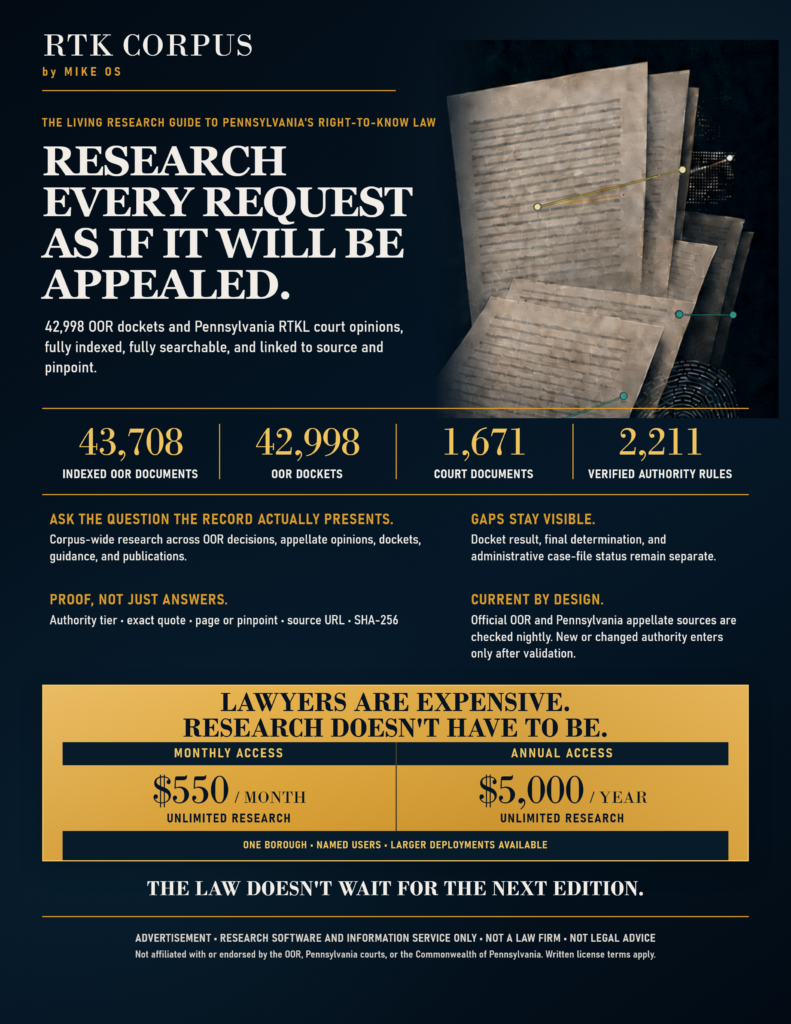
The material represents that RTK Corpus contains tens of thousands of indexed Office of Open Records documents and dockets, Pennsylvania RTKL court materials, and thousands of “verified authority rules.”
It also describes the system as conducting corpus-wide research across OOR decisions, appellate opinions, dockets, guidance, and publications, with source citations and pinpoint references.
A Commercial Research Service
Of particular note, the material received by the Borough does not merely describe a private research project.
It expressly advertises paid access to RTK Corpus:
$550 per month for unlimited research; or
$5,000 per year for unlimited research.
The advertisement states that access is for “One Borough” with named users and that larger deployments are available.
It concludes:
“Lawyers are expensive. Research doesn’t have to be.”
and identifies the offering as an “Advertisement · Research Software & Information Service Only.”
Originating August 5, 2026, Email and RTK Corpus Advertisement from Michael Long
Late Afternoon August 5th, Long Sends Correction Email and New Flyer
Why the Borough is Publishing this Correspondence?
In August 2026, Borough officials received promotional materials from Michael Long for two software products: RTK Corpus, advertised as a Pennsylvania Right-to-Know Law research service at $550 per month or $5,000 per year, including a tier identified for “One Borough”; and MIKE OS, advertised as a platform for collecting, preserving, analyzing, and presenting digital and financial evidence.
Mr. Long has been the requester in eight Right-to-Know appeals involving the Borough since 2022.
The Borough asked a direct question — whether these systems had been used in connection with Bath Borough matters — and did not receive an answer. Mr. Long stated that he had not provided the Borough with that information.
The Borough publishes the correspondence so residents can read it directly. The Borough draws no conclusion from it beyond what the documents show on their face, and residents are capable of reading the exchange and forming their own view.
August 5: “Did You Use RTK Corpus?”
At 5:50 p.m. on August 5, Borough Manager Bradford Flynn asked Mr. Long:
“Mike — out of curiosity, did you use RTK Corpus to research or prepare any of your recent RTKL filings involving the Borough?”
Mr. Long responded at 6:54 p.m., but his response did not state whether he had used RTK Corpus to research or prepare his recent RTKL filings involving the Borough.
The OOR material he supplied contains a new warning that AI tools can generate false citations, quotations, summaries, and facts and places responsibility upon parties using AI to ensure submissions are factually and legally accurate.
At 7:37 p.m., Flynn narrowed the question:
“I was simply curious whether you have used RTK Corpus to research, develop, or prepare any of your RTKL requests, appeals, submissions, or related filings involving the Borough of Bath. Yes or no is fine…”
August 5th Email Exchange Regarding Use of RTK Corpus in Bath Borough Matters
August 6: The Discussion Expands to a “Much Larger Stack”
The following morning, Mr. Long responded with what appeared to be a deliberately tongue-in-cheek description of a possible automated OOR workflow:
“If I were that smart, I would probably use email notifications to trigger an automation that logged into the portal extracted any new files and then automatically produced and uploaded a response…”
He continued:
“But if I were, that would only be a small part of a much larger stack.”
He then stated that he instead “just read[s] every OOR Final Determination and court opinion regarding the RTK law ever written, then spend[s] weeks writing and rewriting” his filings.
The reference to a “much larger stack” introduced an additional concept into the exchange but did not answer the Borough’s original question concerning whether RTK Corpus had been used in Bath Borough matters. Mr. Long later explained the general technological meaning of the term “stack,” but did not identify the specific components of the “much larger stack” he had referenced. As the correspondence continued, the Borough therefore sought to distinguish among RTK Corpus, MIKE OS, and whatever additional tools or workflows Mr. Long may have been referring to as part of that broader technology.
Redaction aside from personal identifying information, also involved commentary related to an unrelated investigation.
MIKE OS: Additional Materials Provided by Long
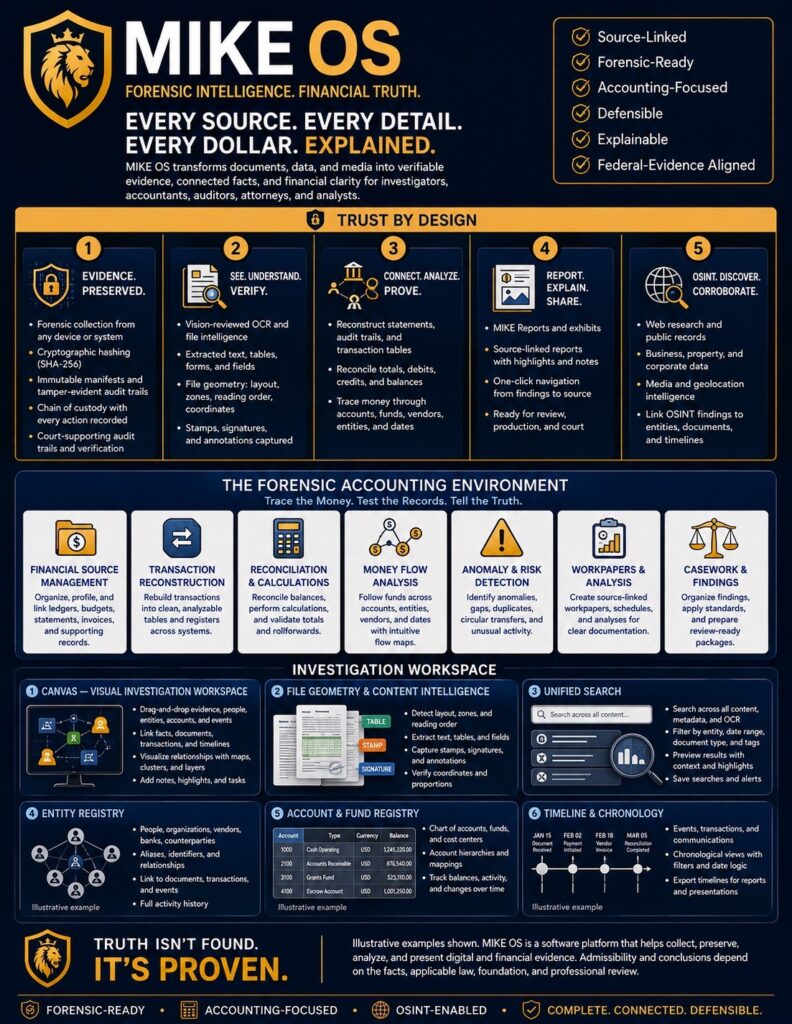
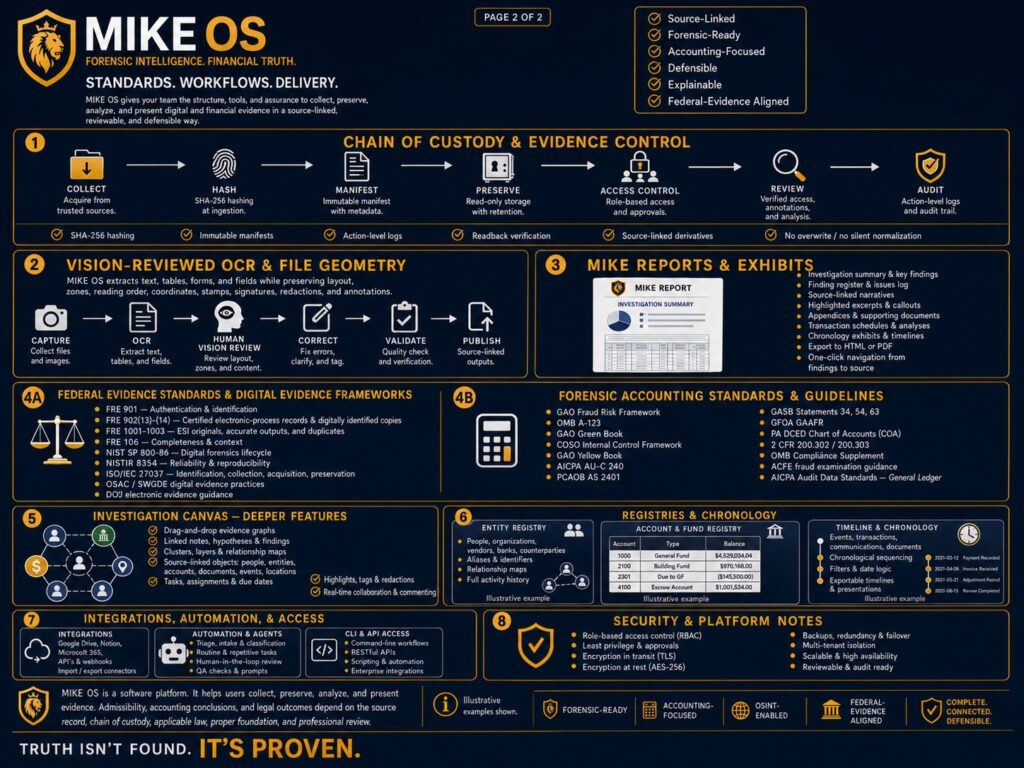
Mr. Long subsequently provided two additional promotional images for MIKE OS and additional context concerning the broader technology he had referenced.
Those materials described a broader set of forensic, accounting, investigative, and automation capabilities than those identified in the RTK Corpus flyer.
MIKE OS is expressly described in the promotional material as:
“a software platform that helps collect, preserve, analyze, and present digital and financial evidence.”
The promotional materials identify capabilities including:
- forensic collection of electronic evidence;
- cryptographic hashing and chain-of-custody records;
- OCR and document analysis;
- transaction reconstruction;
- reconciliation of financial balances;
- money-flow analysis;
- anomaly and risk detection;
- financial-source management;
- account and fund registries;
- entity relationship mapping;
- timeline and chronology development;
- source-linked reports and exhibits;
- web research and public-record research;
- integrations with Google Drive, Microsoft 365, Notion, APIs and webhooks; and
- automation and agents for “triage, intake & classification” and “routine & repetitive tasks.”
The material also describes an “Investigation Workspace” capable of linking evidence, people, entities, accounts, documents, transactions, events and timelines.
Separate sections specifically describe “Forensic Accounting Standards & Guidelines” and an “Account & Fund Registry,” including chart-of-accounts, funds, cost centers, balances, activity and changes over time.
The Borough has not independently tested MIKE OS and makes no representation that the advertised capabilities have been implemented or operate as described. These are representations contained in the materials provided by Mr. Long.
Attachments to Long’s August 6 2:57 PM Email
August 6: Long Describes the “Stack”
Later on August 6, Mr. Long explained that, in technology, a “stack” generally refers to a collection of technologies used to build an application.
He also wrote:
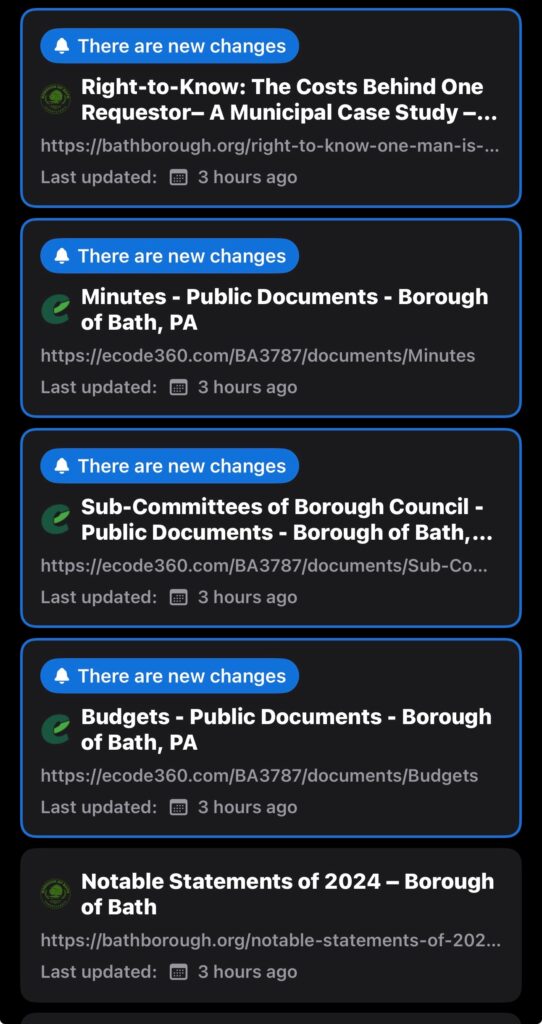
“Furthermore, your questionable changes and minor refinements have been monitored for years.”
The communication included an image showing automated notifications of changes to several public Borough webpages, including the Borough’s Right-to-Know cost page, public minutes, committee information, and budget records.
Attachments to Long’s August 6 4:45 PM Email
August 6: Long Clarifies What He Has — and Has Not — Disclosed
At 7:04 p.m. on August 6, Mr. Long sent another email seeking to clarify the record.
He explained that his reference to monitoring concerned automated change detection on publicly accessible Borough webpages, rather than monitoring Borough “public information” generally.
More importantly for the RTK Corpus/MIKE OS question, Mr. Long expressly stated:
“That statement was also not an answer to, and should not be construed as an answer to, your questions concerning RTK Corpus, MIKE OS, their architecture, data sources, inputs, testing, training, or their use in any particular RTKL matter. I have not provided you with that information.”
That clarification is important.
The Borough therefore does not interpret Mr. Long’s earlier statements about website monitoring, automation, or a larger technological “stack” as establishing that RTK Corpus or MIKE OS was used in a particular Bath Borough matter.
Rather, Mr. Long himself has now expressly stated that he has not provided the Borough with that information.
Although Mr. Long clarified several earlier statements, he did not directly answer whether RTK Corpus or MIKE OS had been used in connection with any Bath Borough Right-to-Know matter. Instead, he stated that he had “not provided the Borough with that information.” As written, that statement addresses what information had or had not been disclosed to the Borough, rather than whether RTK Corpus or MIKE OS had been used. The Borough therefore continues to treat that question as unanswered.
Accordingly, the Borough’s documentary timeline distinguishes between what Mr. Long has expressly stated, what can be independently verified from the documentary record, and questions that remain unresolved.
August 7: The Borough Responds
On August 7, Flynn acknowledged Long’s request that his statements be characterized according to what they actually establish.
The Borough agrees with that principle.
The response also distinguished Long’s later neutral explanation of webpage change detection from his original statement that the Borough’s “questionable changes and minor refinements have been monitored for years.”
Flynn advised that if Long believed a particular Borough website change was improper, he should identify the particular change and explain why.
What Is Established — and What Is Not
Following this exchange, the Borough believes the documentary record permits several straightforward observations.
The materials establish that:
- Mr. Long supplied Borough officials with promotional material for a product identified as “RTK CORPUS by MIKE OS.”
- The material advertises RTK Corpus as a Pennsylvania Right-to-Know Law research service.
- RTK Corpus is advertised commercially (according to Long’s emails) at $550 per month or $5,000 per year, including an offering specifically identified for “One Borough.”
- Mr. Long subsequently supplied promotional material describing MIKE OS as a software platform for collecting, preserving, analyzing, and presenting digital and financial evidence.
- The advertised MIKE OS capabilities include extensive financial-record, accounting, transaction, investigative, public-record, and automation functionality.
- Mr. Long referenced a “much larger stack” and subsequently explained what he meant by the technological term “stack.”
- Mr. Long stated that automated change detection had been used to detect and document changes to publicly accessible Borough webpages.
What the Borough Is Not Claiming
The Borough is not claiming that Bath Borough records were used to develop, train, test, or populate either system, and no evidence in the Borough’s possession establishes that. The Borough is not claiming that developing or selling research software is improper, or that a requester must explain why records are wanted. The Right-to-Know Law does not permit an agency to inquire into a requester’s purpose, and the Borough has not done so.
What the Record Does Show
The Borough notes two documented facts and confines itself to them.
In September 2025, in Long v. Bath Borough, OOR Dkt. AP 2025-1943, the Pennsylvania Office of Open Records found that filings submitted by Mr. Long contained “multiple instances of citations or quotes that do not exist, making [the Petition] inherently unreliable,” and cautioned him that “AI routinely hallucinates the existence of case law.”
In August 2026, eleven months later, Mr. Long provided Borough officials with promotional materials for RTK Corpus — a commercial Pennsylvania Right-to-Know research service advertised on the strength of “verified authority rules,” “source citations and pinpoint references,” and the instruction to “Research Every Request As If It Will Be Appealed.”
Both rulings are linked below, and both promotional documents are part of this webpage above. The Borough offers no theory about the relationship between them.
OOR AP 2025-1943 Final Determination
Requester’s Petition for Reconsideration
OOR DENIES Petitioner’s Request for Reconsideration
Why This Matters Beyond Bath?
Following this exchange, the Borough Manager wrote to the office of Senator Nick Miller, who represents the Borough of Bath in the 14th Senatorial District, regarding the statewide implications of AI-assisted Right-to-Know activity. The Borough’s Right-to-Know counsel followed with supporting correspondence.
Appeals to the Pennsylvania Office of Open Records rose from 3,227 in 2024 to 3,970 in 2025. December 2025 alone saw 448 appeals, an 88 percent increase over the prior December. The Office has reported that AI-assisted submissions frequently contain hallucinations and inaccuracies, and that it would require two to three additional attorneys annually to keep pace.
The Right-to-Know Law was written for a world in which producing a legal filing required either training or expense. That is no longer the world Pennsylvania municipalities operate in. The Borough believes the General Assembly should consider what obligations attach to parties who submit AI-generated material to a Commonwealth tribunal, and what recourse an agency has when those obligations are not met.
Read more here: Right-to-Know in Pennsylvania During the Age of AI
Right of Response
Mr. Long is invited to submit a response to this page. If he does, the Borough will publish it here in full and unedited, subject only to redaction of personal identifying information.
Related Borough Information & Proceedings
For additional background concerning Michael Long’s Right-to-Know Law activity involving Bath Borough, related administrative and judicial proceedings, public costs, and other documented matters, see:
Right-to-Know: The Costs Behind One Requestor– A Municipal Case Study -The Borough’s cumulative accounting and history of costs associated with Long’s records activity through multiple years.
Artificial Intelligence and the Right-to-Know Law: Bath Borough Experience — The Borough’s broader discussion of AI-generated or AI-assisted RTKL submissions and issues arising from prior Long proceedings.
OOR Docket AP 2026-2665 – ACTIVE — Long’s 2026 appeal involving approximately nine years of Borough financial and accounting records.
OOR Docket AP 2025-1943 – CLOSED — Financial/accounting-record appeal that included substantial filings and later proceedings concerning Long’s legal authorities and request for reconsideration.
Court Proceedings Following OOR AP 2025-1943 — Borough page documenting Long’s subsequent Petition for Review in Northampton County Court of Common Pleas.
OOR Docket AP 2023-1598 – CLOSED — Earlier Long proceeding that ultimately resulted in litigation before the Northampton County Court of Common Pleas and later compliance proceedings.
OOR Docket AP 2023-1083 – CLOSED — Long appeal involving financial records, audit trails, legal invoices, emails and other Borough records.
OOR Docket AP 2024-0001 – CLOSED — Consolidated Long matter in which more than 1,000 pages of digital records were ultimately released and the appeal was withdrawn.
OOR Docket AP 2023-2949 – CLOSED — Long appeal dismissed by OOR as premature.
